
Scrapping the CGT Discount
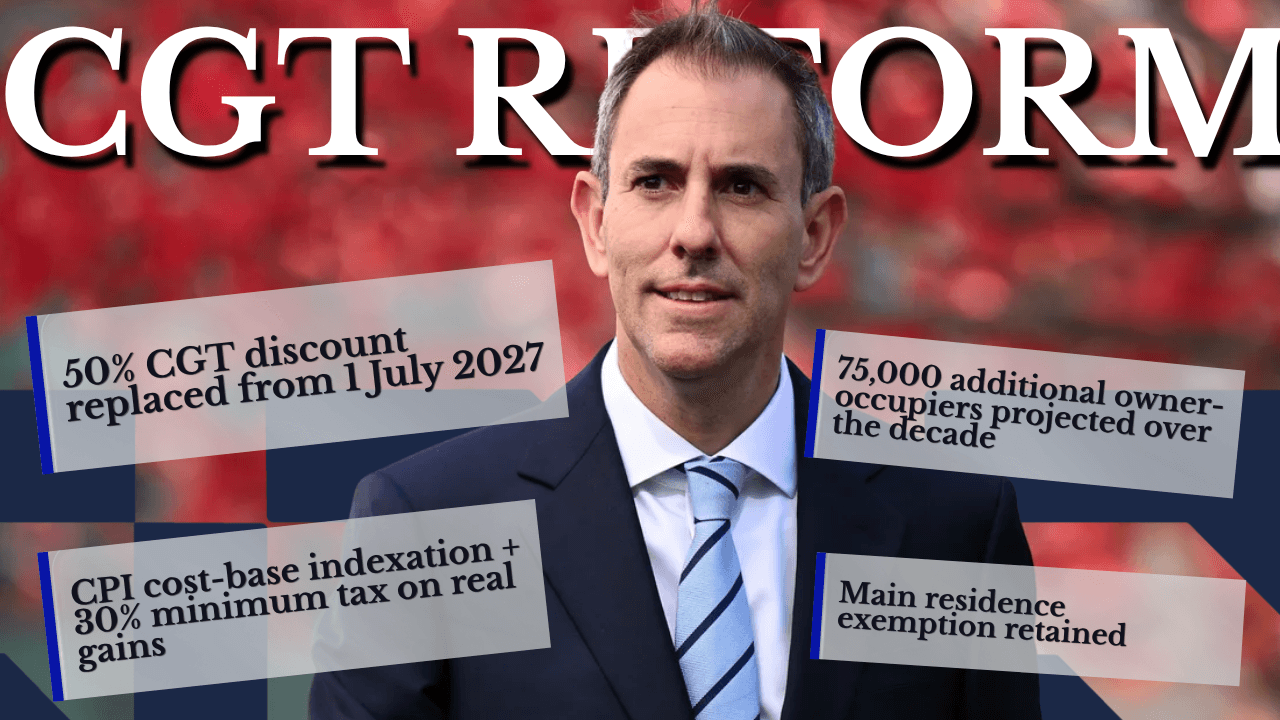
From 1 July 2027, the Albanese Government will replace the 50 per cent capital gains tax (CGT) discount with cost base indexation and a 30 per cent minimum tax on real capital gains, applying prospectively to gains accruing from that date.
Economy
Budget 2026-27
The 50 per cent CGT discount was introduced in 1999, halving the taxable capital gain on assets held for more than 12 months. It replaced the prior cost base indexation regime that had operated since 1985. The flat discount tends to overcompensate investors with high returns (well above inflation) and undercompensate investors whose gains barely outpace prices. Since 1999, Australian housing prices have risen more than twice as fast as average full-time earnings, and between 2001 and 2021 the home ownership rate for 25 to 34 year olds fell by seven percentage points. The OECD recommended in its most recent country report on Australia that the discount be cut or eliminated alongside changes to negative gearing.
What Changed
From 1 July 2027, the 50 per cent discount will be replaced with two mechanisms working together:
Cost base indexation. An asset's cost base will be adjusted upward using the Consumer Price Index (CPI), similar to the regime that applied between 1985 and 1999. Investors will pay tax only on real (above-inflation) gains.
A 30 per cent minimum tax. Real capital gains will be taxed at a minimum rate of 30 per cent. This aligns with the marginal tax rate paid by wage earners on incomes between $45,001 and $135,000. People whose marginal rate is already at or above 30 per cent pay their normal rate on the real gain.
The reform applies to all CGT assets, including property and shares, held by individuals, partnerships, and most trusts for at least 12 months.
Transitional Arrangements
The changes apply only to gains accruing from 1 July 2027. There is no retrospective effect.
Assets bought and sold before 1 July 2027 are unaffected.
Assets bought after 1 July 2027 are treated wholly under the new arrangements.
Assets owned before 1 July 2027 and sold afterwards are split: the 50 per cent discount applies to the gain accrued before that date (using the asset's value at 1 July 2027 as the new cost base), and indexation plus the minimum tax apply to the gain accrued after.
Taxpayers can determine an asset's value at 1 July 2027 either by obtaining a valuation (including by using quoted prices for shares) or by applying an apportionment formula based on the asset's growth rate over its holding period. The ATO will provide tools to assist. Pre-1985 assets remain exempt for gains accrued before 1 July 2027.
New Build Exemption
Investors who buy new residential builds can choose between the existing 50 per cent CGT discount and the new indexation arrangements, and retain access to negative gearing. The exemption is restricted to dwellings that genuinely add to housing supply: new constructions on vacant land, or redevelopments that increase the number of dwellings on a site. Knock-down rebuilds that do not increase supply, substantial renovations, and granny flats attached to existing properties are not eligible. The exemption attaches to the original purchaser only; subsequent purchasers cannot access the 50 per cent discount on that property.
Other Exemptions
The main residence exemption remains in place. The four small business CGT concessions are unchanged. The existing 60 per cent CGT discount on qualifying affordable housing is fully retained. Recipients of means-tested income support payments, such as the Age Pension or JobSeeker, are exempt from the 30 per cent minimum tax in any year they receive a payment. Widely held trusts (including most managed investment trusts) and superannuation funds (including SMSFs) are also excluded. The Government will consult on the interaction of the reform with incentives for investment in early-stage and start-up businesses.
What It Means in Practice
Treasury analysis shows that, had cost base indexation been in place over the past 20 years, the effective discount on typical assets held for five or ten years would have ranged from around 35 to 60 per cent. The effective tax rate on the nominal gain for a high-income earner would have sat between 13 and 30 per cent, depending on returns, holding period, and inflation.
Investors with modest real returns will pay less tax than under the 50 per cent discount; those with very high returns will pay more. As an illustration: an investor earning a 2.5 per cent annual return on an asset held over ten years would pay no CGT under indexation (the return only matches inflation), where they would have had a taxable gain under the discount. An investor earning a 7.5 per cent annual return on the same asset would pay materially more than under the old discount.
Housing Impact
Combined with the negative gearing changes, Treasury modelling estimates the CGT reform will result in around 75,000 additional owner-occupiers over the next decade, equivalent to reversing about ten years of decline in the home ownership rate. House price growth is expected to slow by roughly 2 per cent over a couple of years before recovering. Rents are expected to increase by less than $2 per week for a household paying the median rent. The Budget's housing supply measures, including the $2 billion Local Infrastructure Fund, are expected to more than offset any small drag on supply from the tax changes.
Who's Affected
Around 7 per cent of individual taxfilers (about 1.1 million in 2022-23) report a net capital gain each year. Most rely on the existing CGT discount because the relevant assets are held for more than 12 months.
Key Figures
30 per cent minimum tax on real capital gains from 1 July 2027
50 per cent CGT discount replaced by CPI-based cost base indexation
Around 1.1 million individuals report a net capital gain in a typical year
75,000 additional owner-occupiers projected over the decade (combined with the negative gearing reform)
Effective discount under indexation: 35 to 60 per cent on typical assets held five to ten years
House price growth expected to slow by around 2 per cent over a couple of years
$3.5 billion budget improvement over the forward estimates (combined with negative gearing reform)
Sources
[1] Treasury fact sheet: Negative Gearing and Capital Gains Tax Reform
[2] Budget 2026-27: Tax reform for workers, businesses and future generations
Updated: