Supporting Small Business
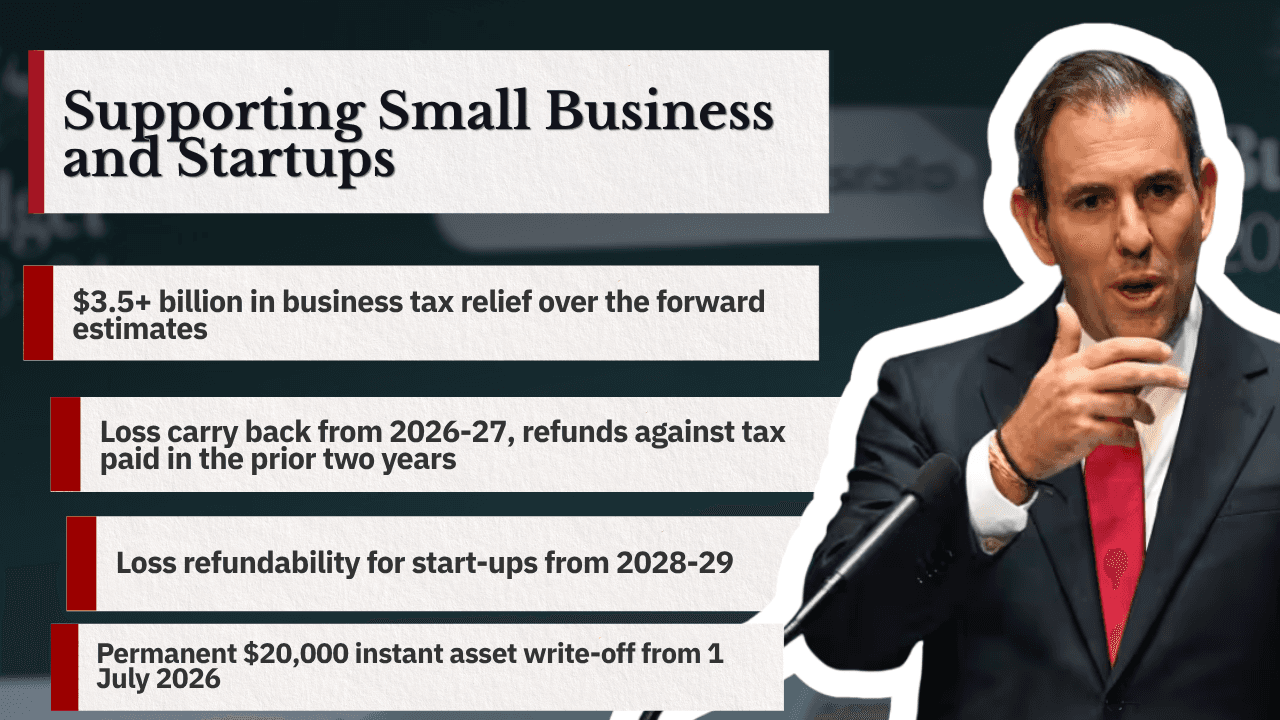
The Budget contains more than $3.5 billion in tax relief for businesses and start-ups, with a permanent $20,000 instant asset write-off, the reintroduction of loss carry back, refundability for start-up losses, and a package of administrative simplifications.
Economy
Budget 2026-27
Small business has historically relied on a patchwork of temporary tax concessions, with measures like the $20,000 instant asset write-off extended year by year and loss carry back relief withdrawn after its COVID-era introduction. The Budget shifts several of these measures from short-term extensions to permanent settings, while adding new cash flow support for loss-making early-stage businesses.
Permanent $20,000 Instant Asset Write-Off
From 1 July 2026, the $20,000 instant asset write-off (IAWO) is being made permanent. Small businesses with aggregated turnover up to $10 million can immediately deduct eligible assets costing less than $20,000, rather than depreciating them over multiple years.
The measure is estimated to improve cash flow for small businesses by around $890 million over the next five years and reduce compliance costs by around $32 million per year. Making the threshold permanent removes the annual uncertainty about whether the concession will be extended, which has historically complicated investment decisions.
Loss Carry Back
From 2026-27, eligible companies that make a loss in the current income year will be able to apply that loss against tax paid in the prior two income years and receive a refund. The measure is expected to benefit up to 85,000 companies, the majority of which are small businesses.
Loss carry back is being permanently reintroduced after the COVID-era version of the scheme expired. It is intended to support business risk-taking and resilience, allowing companies to recover tax already paid when their fortunes turn rather than carrying losses forward indefinitely against future profits that may not arrive.
Loss Refundability for Start-Ups
From 2028-29, small start-ups in their first two years of operation will be able to claim a refund for tax losses, capped at the value of fringe benefits tax and pay-as-you-go (PAYG) withholding tax paid on employee wages. The measure is expected to benefit around 25,000 young companies each year.
Refundability is targeted at the period before a start-up is generating taxable profits. By unlocking cash now rather than requiring losses to be carried forward until profitability, it provides early-stage businesses with working capital to hire and invest.
Simpler Tax Administration
The Budget also includes administrative changes designed to reduce small business compliance costs:
From 1 July 2027, businesses will have the flexibility to opt in to monthly PAYG instalments rather than quarterly.
Access is being expanded to the ATO's dynamic instalments pilot, which uses business software to more accurately calculate PAYG instalments in real time. About two million businesses are eligible.
The Government will work with states on harmonising and simplifying payroll tax administration.
Combined with the $1,000 instant tax deduction for individual workers, the simplification package is estimated to save businesses and workers over $500 million per year in compliance costs.
Key Figures
$3.5+ billion in business tax relief over the forward estimates
$20,000 instant asset write-off made permanent from 1 July 2026
$890 million improvement in small business cash flow over five years from the IAWO
Up to 85,000 companies benefit from loss carry back, most of them small businesses
Up to 25,000 start-ups benefit from loss refundability each year from 2028-29
$32 million annual compliance saving from IAWO permanence
$500+ million annual compliance saving across the tax simplification package
~2 million businesses eligible for the ATO's dynamic instalments pilot
Sources
[1] Budget 2026-27: Tax reform for workers, businesses and future generations
Updated: