Closing Trust Loopholes
The Albanese Government will introduce a 30 per cent minimum tax on discretionary trust income from 1 July 2028, narrowing a long-standing gap that has allowed families using trusts to split income across relatives and pay tax at lower marginal rates than comparable wage earners.
Economy
Budget 2026-27
Maybe the most underrated part of this budget: fixing the trusts loophole
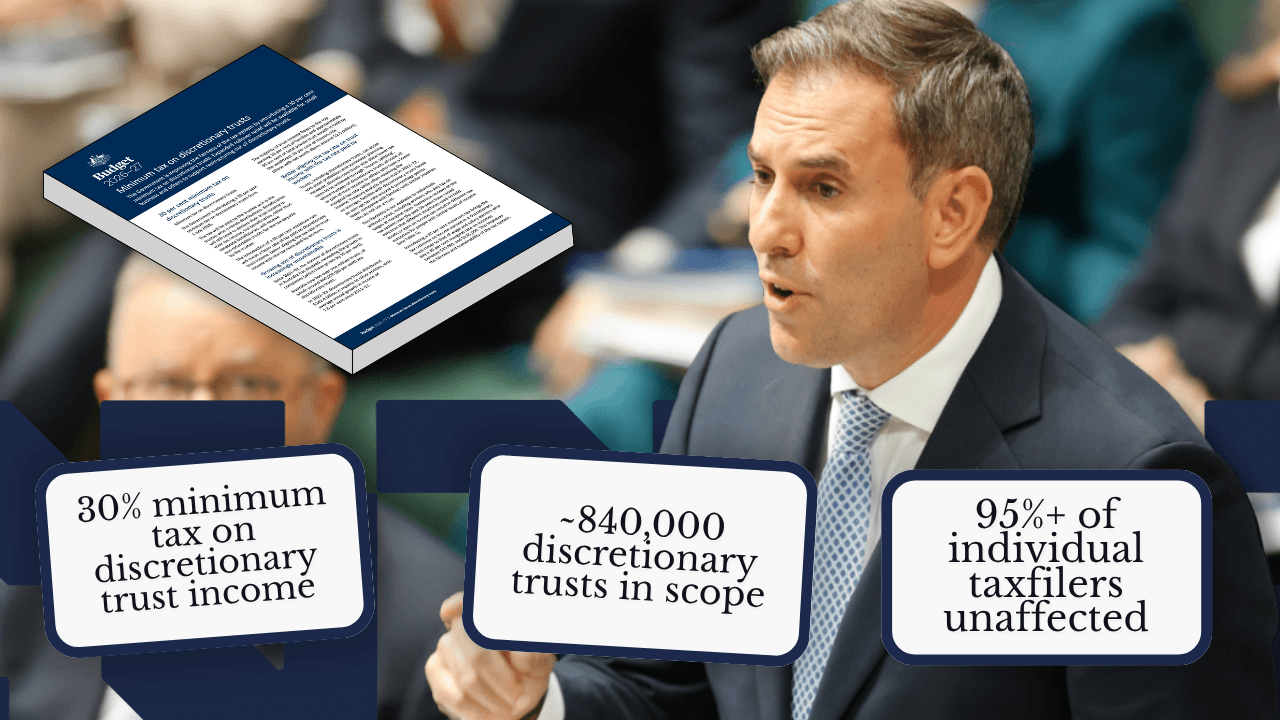
Australia has more than one million trusts, around 840,000 of which are discretionary. The number of discretionary trusts has doubled since 2001-02, outpacing the 70 per cent growth in companies over the same period. In 2022-23 alone, discretionary trusts distributed $142.4 billion in income to other entities, with average annual growth of 7.8 per cent since 2011-12. Around 90 per cent of total private trust wealth is held by the wealthiest 10 per cent of households (those with net worth above around $2.3 million).
The structure's appeal is well known. Trustees of a discretionary trust can choose each year which beneficiaries receive trust income, which allows income generated by a single high earner to be allocated across family members on lower marginal tax rates. Treasury analysis shows families using discretionary trusts faced an average tax rate around 4 percentage points lower in 2022-23 than families on similar incomes who do not use a trust. Wage and salary earners do not have an equivalent option. Reviews of the tax system going back fifty years, including the 1975 Asprey Report, the 1999 Review of Business Taxation, the 2009 Henry Review (Australia's Future Tax System), and the 2015 Re:think paper, have raised the same concern.
How it works
From 1 July 2028, the trustee of a discretionary trust will pay a minimum 30 per cent tax on the trust's taxable income. Beneficiaries will continue to declare trust distributions in their own tax returns, with non-corporate beneficiaries receiving a non-refundable credit for the tax already paid by the trustee. The 30 per cent rate aligns with the marginal tax rate paid by wage and salary earners on incomes between $45,001 and $135,000.
Where a trust already distributes to beneficiaries on a marginal rate of 30 per cent or higher, no additional tax is paid. Trustees that receive franked dividends will be required to use their franking credits to pay the minimum tax, and the treatment of any excess franking credits will be settled through consultation.
To prevent the use of 'bucket' companies as a workaround, corporate beneficiaries will not receive non-refundable credits for tax paid by the trustee. ATO data shows around 80,000 companies received discretionary trust distributions in 2022-23, and 83 per cent of those companies had no evidence of business activity, indicating they operate primarily for tax purposes.
Who's affected
More than 95 per cent of individual taxfilers will be unaffected in any given year. In 2022-23, around 810,000 adults (5 per cent of taxfilers) received discretionary trust distributions, along with 120,000 non-filers, predominantly minors. Around half of all discretionary trusts are not expected to be affected in any given year.
For small businesses, around 350,000 (less than 15 per cent of all active small businesses) operate through a discretionary trust. Of those, 40 per cent (140,000) are not expected to pay additional tax or need to restructure in any given year. More than 90 per cent of small businesses overall will be unaffected.
Rollover relief and restructuring
Expanded rollover relief will be available for three years from 1 July 2027 for small businesses and others who choose to restructure out of a discretionary trust into a company or a fixed trust. The relief exempts the restructure from income tax consequences, including capital gains tax (CGT). From 1 January 2027, the Australian Small Business and Family Enterprise Ombudsman will help small businesses understand their options, and the Australian Securities and Investments Commission (ASIC) will set up specific arrangements to support incorporation.
Restructuring into a company gives access to the 25 per cent small business corporate tax rate (for businesses with aggregated turnover under $50 million and no more than 80 per cent passive income), dividend imputation, simpler retained earnings, and easier access to debt and equity finance. Restructuring into a fixed trust retains the trust form while providing beneficiaries with more certain entitlements. Small businesses can also reduce exposure by employing family members as salaried staff rather than distributing trust income, since wages do not attract the minimum tax.
Exclusions
The minimum tax will not apply to fixed trusts, widely held trusts (including most managed investment trusts), complying superannuation funds, special disability trusts, deceased estates, or charitable trusts. Specific income types are also excluded: primary production income, certain income relating to vulnerable minors, amounts subject to non-resident withholding tax, and income from assets of testamentary trusts existing at announcement.
International context
Australia has roughly 40 trusts per 1,000 people, well above comparable jurisdictions. The United Kingdom has around 2 trusts per 1,000 people and the United States around 9. Only New Zealand, at 44, has a higher rate.
Key figures
30 per cent minimum tax on discretionary trust income from 1 July 2028
Around 840,000 discretionary trusts affected; about half not expected to pay additional tax in any given year
95+ per cent of individual taxfilers unaffected
90+ per cent of small businesses unaffected
Three-year rollover relief from 1 July 2027
Families with discretionary trusts paid an average 4 percentage points less tax than equivalent non-trust families in 2022-23
$142.4 billion distributed by discretionary trusts in 2022-23
[1] Treasury fact sheet: Minimum tax on discretionary trusts
[2] Budget 2026-27: Tax reform for workers, businesses and future generations
Updated: