
Future made in Australia
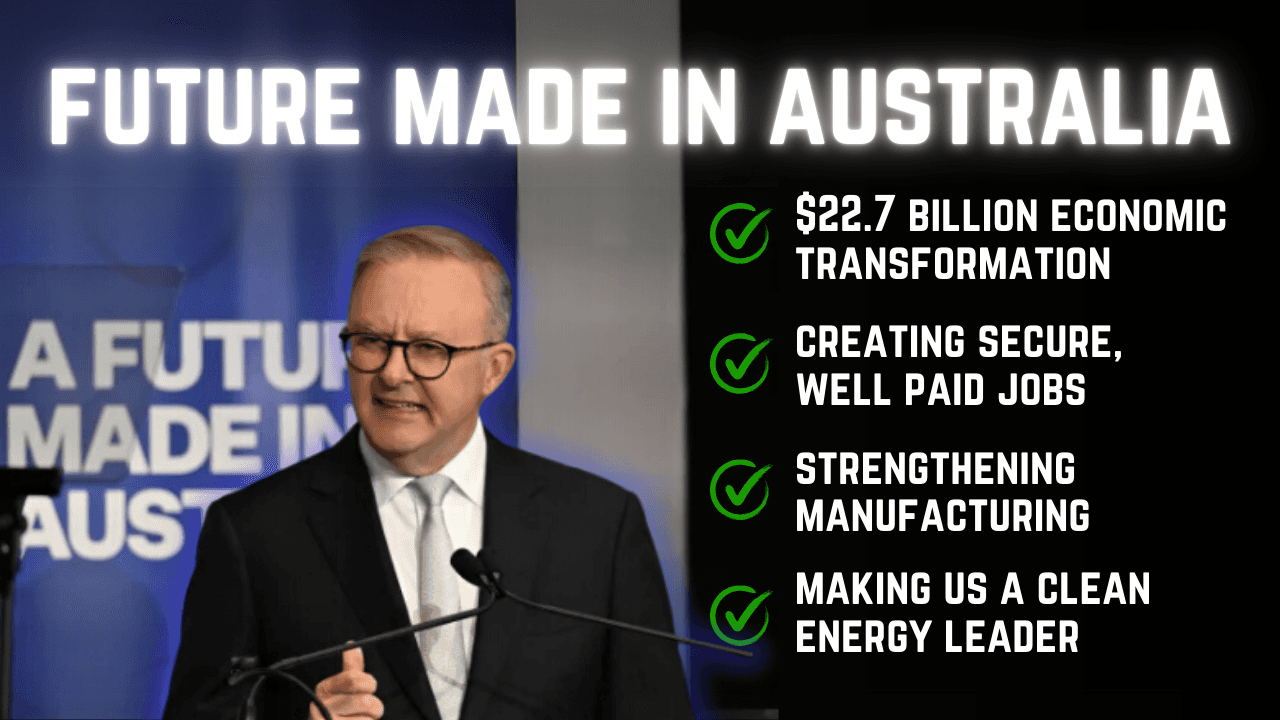
FMIA represents one of the largest economic transformations in recent Australian history. The $22.7 billion investment aims to position Australia as a leader in renewable energy while strengthening our industrial and manufacturing capabilities.
Economy
Term 1
Future Made in Australia is the Albanese Government's industrial policy: a $22.7 billion package announced in the 2024-25 Budget, legislated in November 2024, and built around the argument that Australia should process and manufacture more of what it currently exports as raw material. It is arguably the largest single industrial policy commitment by an Australian government since the tariff era.
Five priority industries were identified under a National Interest Framework: renewable hydrogen, critical minerals processing, green metals, low carbon liquid fuels, and clean energy manufacturing. The Framework divides support into two streams. The Net Zero Transformation stream covers sectors where Australia could have an enduring comparative advantage in a decarbonising world. The Economic Resilience and Security stream covers sectors where some domestic capability is judged necessary for security reasons even where Australia will not be the lowest-cost producer.
Treasurer Jim Chalmers set out the guardrails in a speech in May 2024, framing the agenda as incentivising private investment rather than substituting for it. The design consequence is that the two largest instruments are production tax incentives rather than grants: companies must actually produce before any public money is paid.
The Future Made in Australia (Production Tax Credits and Other Measures) Act 2025 passed on 11 February 2025 and received assent on 14 February 2025. It created the two production tax incentives that account for most of the package:
Hydrogen Production Tax Incentive: $2 per kilogram of eligible renewable hydrogen, available for production between 2027-28 and 2039-40, for a maximum of 10 years per project. Costed at $6.7 billion over the decade.
Critical Minerals Production Tax Incentive: a refundable tax offset worth 10 per cent of eligible processing and refining costs across Australia's 31 listed critical minerals, available from 1 July 2027 to 30 June 2040, for a maximum of 10 years per facility. Uncapped and refundable, meaning a company with no tax liability still receives payment. Costed at $7 bn
Importantly, neither incentive pays for exploration or extraction. Both attach only to downstream processing, which is the point: Australia already digs and ships, and the value it forgoes sits in the refining and manufacturing stages that have concentrated in China.
Instruments under FMIA
Future Made in Australia Innovation Fund. $1.7 billion administered by the Australian Renewable Energy Agency (ARENA), split across $750 million for green metals, $500 million for clean energy technology manufacturing including electrolysers and battery components, and $250 million for low carbon liquid fuels. The package also restored guaranteed statutory funding for ARENA, which had been allowed to lapse under the previous government.
Solar Sunshot. Up to $1 billion announced in March 2024 to build domestic solar photovoltaic manufacturing, with $500 million for module and module-input manufacturing, $50 million for feasibility and front-end engineering studies, and $150 million for balance-of-plant and deployment systems.
Battery Breakthrough Initiative. $500 million launched in August 2025 under the National Battery Strategy, delivered by ARENA.
Hydrogen Headstart. $2.25 billion in production credits, first announced in the 2023-24 Budget and expanded under Future Made in Australia. Round 1 concluded in July 2025 with $814 million to Copenhagen Infrastructure Partners' 1,500 megawatt Murchison Green Hydrogen project in Western Australia and $432 million to Orica's Hunter Valley Hydrogen Hub.
Green metals. A $2 billion Green Aluminium Production Credit was announced at the Tomago smelter in January 2025, payable per tonne of low-emissions aluminium from 2028-29 for up to 10 years, with credit rates linked to Scope 2 emissions reductions and a design review scheduled for 2030. A $1 billion Green Iron Investment Fund followed in February 2025, comprising $500 million through a National Development Stream open to projects nationally and up to $500 million earmarked for the Whyalla steelworks. The green metals sectors employ around 42,000 people.
Low carbon liquid fuels. The $1.1 billion Cleaner Fuels Program was announced on 17 September 2025, a ten-year production-linked grant scheme for renewable diesel, sustainable aviation fuel and e-fuels. The Clean Energy Finance Corporation has estimated the sector could be worth $36 billion a year by 2050.
Net Zero Fund. A $5 billion concessional finance vehicle announced on 18 September 2025 alongside the Industry Sector Plan, drawn from the existing $15 billion National Reconstruction Fund. Its design was finalised in February 2026 with a target rate of return of the five-year government bond rate minus 1 per cent, against the National Reconstruction Fund general portfolio's bond rate plus 2 to 3 per cent. The lower hurdle is intended to let it fund first-of-a-kind industrial decarbonisation that commercial lenders will not touch. Applications opened in April 2026.
Investor Front Door. Announced in the 2024-25 Budget to give major projects a single point of contact across Commonwealth regulators and financing vehicles. The pilot launched on 1 September 2025.
Critical Minerals
The critical minerals leg has moved fastest, largely because geopolitics moved with it. On 24 April 2025 the government committed to a Critical Minerals Strategic Reserve, funded at $1.2 billion in the 2025-26 Budget.
On 20 October 2025, Albanese and United States President Donald Trump signed the United States-Australia Framework for Securing of Supply in the Mining and Processing of Critical Minerals and Rare Earths. Each government committed at least USD$1 billion within six months towards a USD$8.5 billion pipeline of priority projects. The first two Australian projects named were the Alcoa-Sojitz gallium recovery project at Wagerup in Western Australia and Arafura's Nolans rare earths project in the Northern Territory. The framework also contemplates price floors and coordinated stockpiling, which is a significant departure: it accepts that rare earths markets are subject to deliberate price suppression and that ordinary market signals will not build the supply chain on their own.
SEPTEMBER 2026 UPDATE
Three things shaped 2026: a global fuel supply shock from the Middle East conflict, the continued retreat of private capital from large-scale green hydrogen, and accelerating allied co-investment in critical minerals. The 2026-27 Budget, handed down on 12 May 2026, narrowed Future Made in Australia towards the parts that were delivering.
Funding was withdrawn from three clean energy programs
The Budget clawed back $1.3 billion in uncommitted funds: $1 billion from Hydrogen Headstart Round 2, halving it, and $300 million from Solar Sunshot and the Battery Breakthrough Initiative. The Battery Breakthrough Initiative fell to $142.32 million and ARENA stopped taking applications. The government's position is that only unallocated money was withdrawn and committed projects are unaffected. It is the first material contraction of the package.
Hydrogen kept contracting
ARENA shortlisted seven Headstart Round 2 projects on 13 May 2026, totalling 2.18 gigawatts of electrolysis, with outcomes due between late 2026 and early 2027. Against that, BP cancelled its 105 megawatt H2Kwinana project in June 2026 after missing the shortlist, the Australian Renewable Energy Hub dropped its hydrogen and ammonia components in August 2026, and Senate Estimates disclosed that the Kwinana, Gladstone and Townsville hydrogen hubs had been abandoned after receiving $52 million in grants. The counter-example is Orica's Hunter Valley Hydrogen Hub, which reached final investment decision in 2026: 50 megawatts of electrolysis producing around 4,700 tonnes a year to replace gas feedstock at Kooragang Island. It is the one Round 1 project with an identified domestic customer.
Critical minerals delivered its first construction decisions
The Critical Minerals Strategic Reserve was detailed on 12 January 2026, covering antimony, gallium and rare earths, with $1 billion for transactions from an expanded $5 billion Critical Minerals Facility and $185 million for stockpiling. It secures rights to Australian production and on-sells them rather than warehousing stock. Two projects then reached final investment decision under the United States-Australia framework: Arafura's Nolans rare earths project in May 2026, backed by the United States, Germany and South Korea, and the Alcoa-Sojitz gallium plant at Wagerup on 15 July 2026, backed by Australia, the United States and Japan. At 100 tonnes a year, Wagerup would supply roughly 10 per cent of global gallium demand from Alcoa's existing refining stream, with no new mining.
Two aluminium smelters were secured
A power arrangement for the Boyne smelter was finalised in March 2026. On 12 August 2026 the Commonwealth and New South Wales announced $2.5 billion over ten years to keep Tomago open to 2038, split evenly, with Rio Tinto and partners investing at least $1.1 billion. Tomago produces up to 590,000 tonnes a year, close to 40 per cent of national output, and draws roughly 10 per cent of New South Wales electricity. The government's argument is that the deal turns the country's largest electricity user into an anchor customer for nearly three gigawatts of new renewable build. It is the largest smelter support package on record.
Fuel security layer
An $3.2 billion Australian Fuel Security Reserve holding around one billion litres of diesel and jet fuel, and a commitment to a demand-side measure for low carbon liquid fuels alongside the $1.1 billion Cleaner Fuels Program.
Sources:
[1] Budget 2024-25, Investing in a Future Made in Australia https://budget.gov.au/content/03-future-made.htm
[2] Budget 2026-27, Fuel supply and security https://budget.gov.au/content/01-fuel-supply-and-security.htm
[3] Australian Taxation Office, Critical Minerals Production Tax Incentive https://www.ato.gov.au/businesses-and-organisations/income-deductions-and-concessions/incentives-and-concessions/production-tax-incentives/critical-minerals-production-tax-incentive
[4] Department of Industry, Science and Resources, Critical Minerals Strategic Reserve, 12 January 2026 https://www.industry.gov.au/news/strategic-reserve-secure-australias-critical-mineral-supply
[5] ABC News, Federal and NSW governments to split $2.5 billion Tomago Aluminium bailout, 12 August 2026 https://www.abc.net.au/news/2026-08-12/aluminium-smelter-bailout-cost-two-and-half-billion-dollars/107030522
Updated: