
Cutting Red Tape
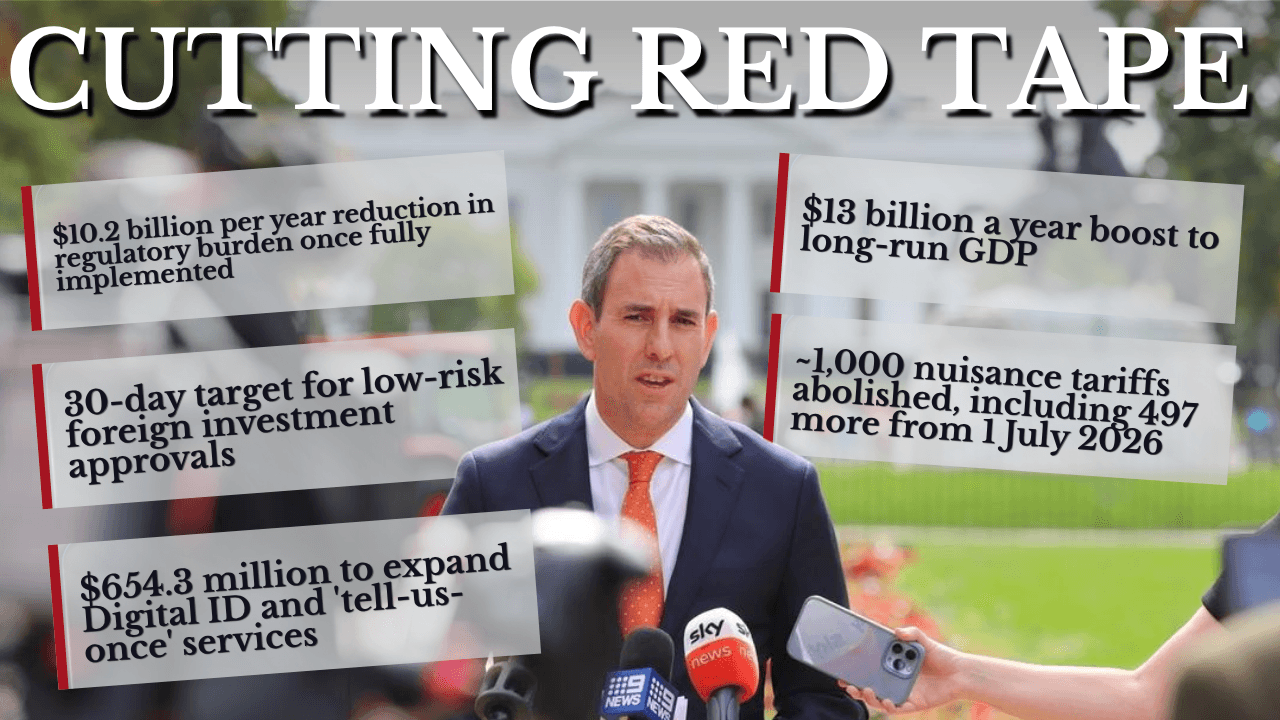
The Budget delivers a package of regulatory reforms estimated to reduce business and individual compliance costs by $10.2 billion per year once fully implemented, alongside a projected $13 billion per year boost to long-run GDP from building a Single National Market. The reforms span environmental approvals, finance, tax administration, trade, digital services, energy markets, skills, and construction.
Economy
Budget 2026-27
The package advances reform directions set by the Treasurer's Economic Reform Roundtable and progresses 13 of the 17 reform areas identified by the Productivity Commission's five pillar inquiries. The Government's stated objective is to make Australia easier to build in, easier to do business in, and easier to invest and innovate in. The largest individual savings come from streamlining environmental approvals, accelerating housing supply, and reducing duplication between Commonwealth and state regulators.
Accelerating Approvals
The single largest contributor to the $10.2 billion estimate is streamlining environmental assessments under the Environment Protection and Biodiversity Conservation Act 1999 (EPBC Act), valued at $3.045 billion per year in reduced regulatory burden. More than $500 million is allocated to implement reforms that deploy artificial intelligence in assessment processes, cut duplication with state regulators, and fund additional bioregional plans and strategic assessments. The Government has said the reforms are intended to strengthen environmental outcomes by shifting from case-by-case approvals to landscape-scale plans.
A new 30-day target is being introduced for decisions on all low-risk foreign investment applications. The Investor Front Door is being strengthened to support nationally significant projects, and resources and telecommunications approvals are also being accelerated.
Building a Single National Market
National Competition Policy reforms being progressed with the states and territories are estimated to deliver $2.05 billion per year in reduced regulatory burden once fully implemented. The reforms include:
Working with states to harmonise payroll tax administration.
National occupational licensing to improve labour mobility.
Allowing health practitioners to work to their full scope of practice.
A national approach to screening care workers.
The full Single National Market is projected to add around $13 billion per year to long-run GDP.
Trade and Tariffs
From 1 July 2026, the Government will abolish a further 497 nuisance tariffs, bringing the total abolished under Labor to around 1,000. The change saves businesses an estimated $157 million per year in compliance costs. Consultation is underway on abolishing additional tariffs. The Australia-EU Free Trade Agreement is being progressed, the Australian Trusted Trader program expanded, and biosecurity border processes streamlined.
Financial Sector Compliance
The Government is progressing 14 legislative reforms to reduce financial sector compliance costs by an estimated $780 million per year, including increasing company reporting thresholds. The Council of Financial Regulators is separately taking 13 actions to streamline data collections under its Better Regulation Roadmap. Combined financial sector savings are estimated at $961 million per year.
Engaging with Government
The Government is implementing a 'tell-us-once' approach to government services, estimated to reduce compliance costs by $190 million per year. A further $654.3 million is being invested to expand the use of Digital ID, enabling safer identity verification and reducing the volume of personal data stored across government systems. An additional $62 million is being invested in the Consumer Data Right, expanding the ways customers can use their own data to access better services and prices.
Skills and Building
$85.2 million is allocated to accelerate skills assessments for migrant trade workers and to fast-track occupational licensing. The permanent migration points test is being reformed to favour better-educated, higher-skilled and younger migrants. A new National Credit Recognition Framework will allow university students to receive credit for relevant TAFE qualifications, shortening degrees.
In construction, free access is being provided to all standards referenced in Australian legislation, saving small businesses and tradies up to $1,600 per year. Barriers to using modern methods of housing construction, including prefabrication, are also being removed.
Trade-offs
The biggest single saving, $3 billion per year from streamlining EPBC assessments, sits alongside the broader environmental law reform agenda. Environmental groups have raised concerns that faster approvals risk weaker scrutiny, particularly where artificial intelligence is used to evaluate applications. The Government has argued environmental outcomes will be strengthened, not weakened, by shifting toward more bioregional plans and strategic assessments rather than relying on individual case-by-case approvals.
The financial sector reforms include increasing company reporting thresholds, which means a smaller number of mid-sized companies will be required to publicly disclose their accounts. This reduces compliance costs but also reduces public transparency for those businesses.
Around half of the $10.2 billion estimate depends on continued cooperation with the states, particularly the National Competition Policy reforms and the Single National Market. Delivery is conditional on state and territory progress.
Key Figures
$10.2 billion per year reduction in regulatory burden once fully implemented
$13 billion per year long-run GDP increase from a Single National Market
$3.045 billion per year saving from streamlining EPBC assessments
$2.05 billion per year saving from National Competition Policy reforms
$961 million per year financial sector compliance savings
$415 million per year saving from simplifying the tax system
$340 million per year saving from using AI to evaluate medicines
$190 million per year saving from 'tell-us-once' reforms
$157 million per year saving from abolishing 497 nuisance tariffs
~1,000 nuisance tariffs abolished under Labor in total
$654.3 million to expand Digital ID
$85.2 million to accelerate migrant skills assessments
Up to $1,600 per year saving for small businesses and tradies from free standards access
13 of 17 Productivity Commission reform areas progressed
Sources
[1] Budget 2026-27 Overview: Making our economy more productive
Updated: