Securing the NDIS
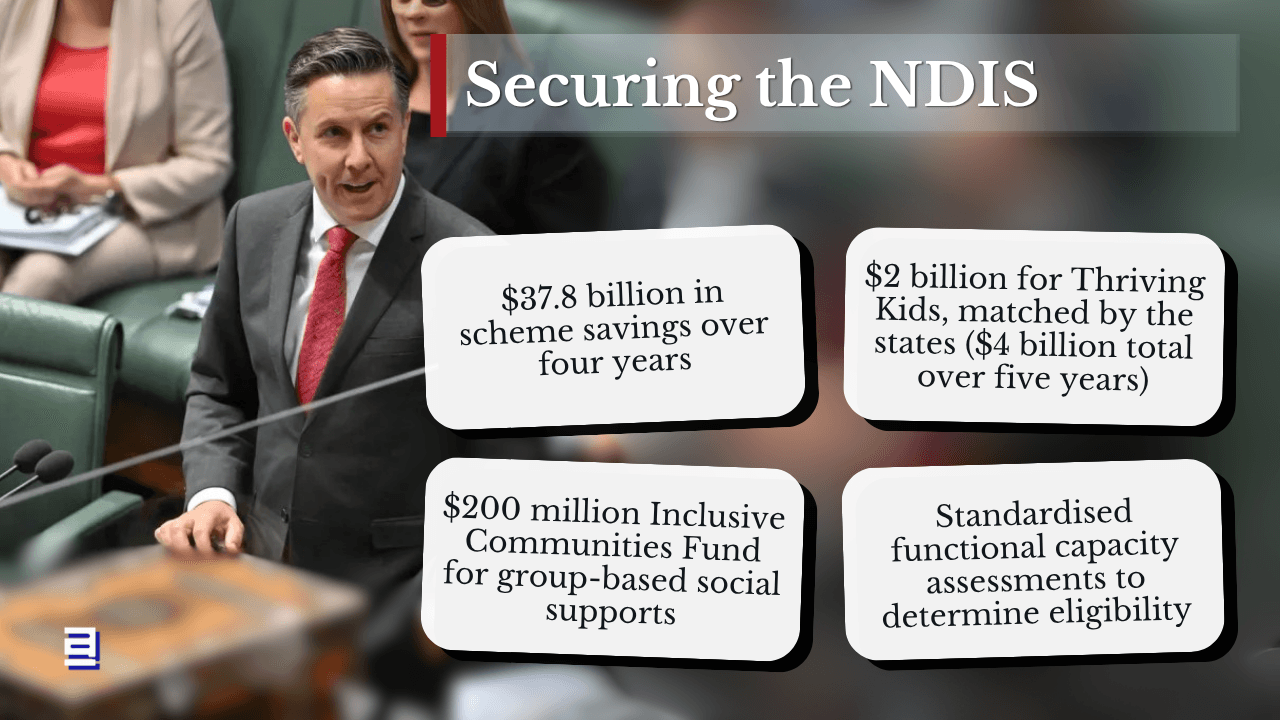
The Albanese Government will tighten NDIS eligibility, plan management and provider oversight to slow scheme cost growth, with reforms expected to save $37.8 billion over four years while preserving access for people with permanent and significant disability.
Health
Budget 2026-27
The NDIS now supports more than 680,000 participants and is Australia's largest social program outside the Age Pension. Annual scheme cost growth, which ran at 23 per cent in the last year of the former Coalition government, has been progressively brought down toward an 8 per cent target. Projected scheme expenses are $210.3 billion over the four years to June 2028. The reforms announced in this Budget aim to keep that trajectory sustainable by returning the scheme to its original intent: supporting people with permanent and significant disability.
Four reform pillars
Quality services and supports. The National Disability Insurance Agency (NDIA) will commission plan management and support coordination, replacing the current arrangement under which participants engage these functions through a fragmented private market. The Government will also consult on a commissioning approach for home and living supports for Supported Independent Living participants, intended to address provider viability and ensure more consistent quality.
Clearer eligibility. Access to the scheme will be determined through standardised, evidence-based assessments of functional capacity, rather than the current reliance on diagnostic labels and varying clinical reports. The intent is consistency across applicants and a tighter link between assessed support need and scheme entry.
Slowing cost growth. Plan reassessment criteria will be tightened and the NDIA will issue stronger guidance on what counts as "reasonable and necessary" supports. Budgets for social, civic and community participation and for capacity-building daily activities will be reset. New Framework Planning, designed to produce more equitable and consistent participant plans, takes effect from April 2027.
Fraud and integrity. The NDIA's investigative and enforcement capabilities will be strengthened, and new regulatory controls introduced to lift oversight of providers and payments. Treasury frames this as protecting participants as well as the scheme.
Thriving Kids and Foundational Supports
The Government is providing $2 billion to establish Thriving Kids, matched by the states for a combined $4 billion over five years. At least $1.4 billion of the Commonwealth's contribution will flow as direct funding to states for service delivery. Thriving Kids is the first phase of a broader Foundational Supports commitment under which the Commonwealth will contribute $5 billion in total, matched by the states.
Thriving Kids will support children aged 8 and under with developmental delay or autism and low-to-moderate support needs, along with their families and carers. Services begin rolling out from 1 October 2026 and the program is expected to be at full scale from 1 January 2028. The intent is to deliver support for these children outside the NDIS, in mainstream community settings such as childcare, schools and health services, rather than through individualised NDIS plans.
A separate $200 million Inclusive Communities Fund will support community organisations to provide group-based social participation programs for NDIS participants.
Implementation timeline
1 October 2026: participant budgets for social, civic and community participation and capacity-building daily activities begin progressive adjustment; Thriving Kids services begin rolling out
April 2027: New Framework Planning commences
1 October 2027: commissioned plan management approach begins, with a six-month transition period
1 January 2028: Thriving Kids at full scale
1 July 2028: newly commissioned support coordination function begins
Trade-offs
The reforms will change what current and future participants receive. Resetting participation and capacity-building budgets means some participants will see lower plan amounts in those categories than they currently receive. Standardised functional capacity assessments may tighten access for applicants who would have qualified under previous arrangements. The shift of children with low-to-moderate support needs from the NDIS into Thriving Kids depends on states delivering matching services on schedule, an outcome that requires sustained co-investment from each state and territory.
The Government's position is that these adjustments preserve the scheme for participants with the greatest need and stop scheme costs crowding out other budget priorities. Without the reforms, Treasury projected scheme cost growth would continue to outpace revenue, putting future commitments at risk. The NDIS will continue to grow each year in absolute terms and remain Australia's largest social program outside the Age Pension.
Key figures
$37.8 billion in scheme savings over four years
$210.3 billion projected scheme expenses over the four years to June 2028
680,000+ current NDIS participants
$2 billion Commonwealth contribution to Thriving Kids; $4 billion joint with states over five years
$1.4 billion+ of the Commonwealth's Thriving Kids contribution paid directly to states
$5 billion total Commonwealth Foundational Supports commitment, matched by states
$200 million Inclusive Communities Fund
Scheme cost growth reduced from 23 per cent in 2021-22 toward an 8 per cent target
Sources
[1] Budget 2026-27: Strengthening care and broadening opportunity
[2] Securing the NDIS for future generations | NDIS
[3] Department of Health, Disability and Ageing: Securing the NDIS
[4] Thriving Kids fact sheet (Department of Health, Disability and Ageing)
[5] Prime Minister: Record funding for public hospitals and disability reform
Updated: