
Backing Startups and Innovation
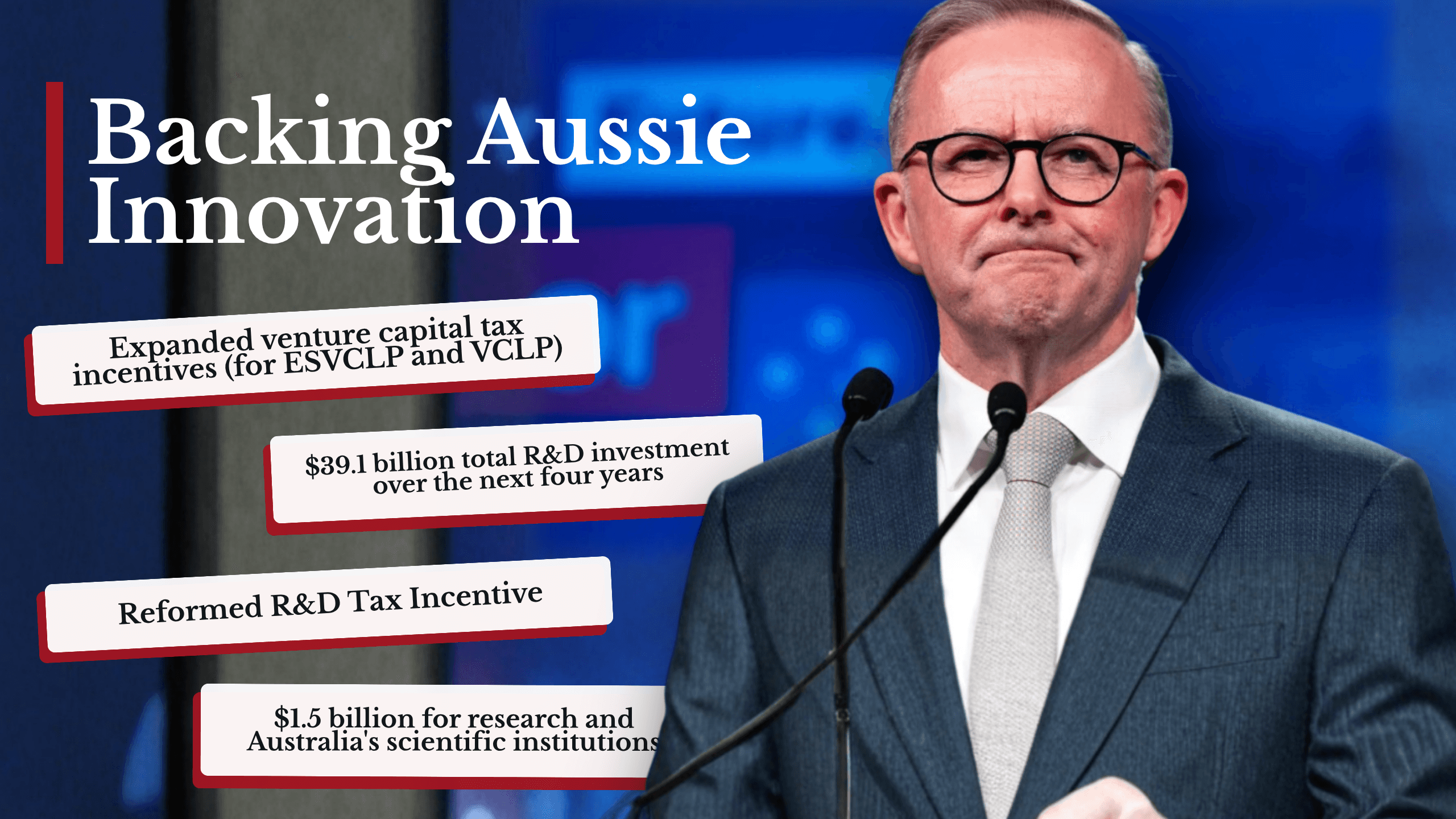
The Budget commits more than $39.1 billion to research and development over the next four years, alongside a reformed R&D Tax Incentive, expanded venture capital tax incentives, $1.5 billion for Australia's scientific institutions, and a new National Resilience and Science Council to coordinate Commonwealth innovation investments.
Economy
Budget 2026-27
The reforms respond in part to the Ambitious Australia Report, which examined Australia's research and development settings against international comparisons. Australia's R&D spending as a share of GDP has lagged the OECD average, and the country's productivity growth has been weak for over a decade. The Budget's innovation package combines structural reform of the main R&D tax instrument with direct investment in research institutions, expanded support for venture capital, and a new coordinating council to align public innovation spending across portfolios.
Despite much whinging from the startup sector, this Government has chosen to back startups, with huge changes to R&D and start-up specific tax changes. Additionally, the Government has signalled they will consult with this community regarding this budget, with carveouts for CGT being speculated for startups.
Reforming the R&D Tax Incentive
From 1 July 2028, the R&D Tax Incentive (RDTI) will be reformed to better target core experimental research and to support young, fast-growing firms. Key changes:
The offset for experimental core R&D will be increased by around 25 to 50 per cent, with eligibility removed for expenditure that only supports R&D rather than constituting R&D itself.
The intensity threshold will reduce to 1.5 per cent, providing higher offsets to firms undertaking substantial core R&D.
The turnover threshold for the higher, refundable offset will be raised to $50 million. Refundability will be limited to firms operating for less than ten years; older firms will be eligible for an equivalent non-refundable offset.
The maximum expenditure cap will be raised to $200 million, encouraging more R&D to be performed onshore.
The minimum expenditure threshold will be raised to $50,000. R&D below that level must be undertaken with a Research Service Provider or Cooperative Research Centre to qualify.
Treasury estimates the reforms will unlock $400 million in additional R&D by young firms each year, and deliver a 20 per cent increase in R&D performed for each dollar of tax offset.
Expanding Venture Capital Incentives
From 1 July 2027, the Government will expand venture capital tax incentives to reflect modern company valuations. Changes to the Early-Stage Venture Capital Limited Partnership (ESVCLP) and Venture Capital Limited Partnership (VCLP) programs include:
ESVCLP cap on eligible investee business assets raised from $50 million to $80 million.
VCLP cap on eligible investee business assets raised from $250 million to $480 million.
ESVCLP cap on investee business assets where investment returns are fully tax exempt raised from $250 million to $420 million.
ESVCLP maximum fund size raised from $200 million to $270 million.
The expanded caps give investors, including superannuation funds, greater flexibility to invest for longer periods, make larger contributions, and back high-growth Australian businesses.
Funding Research and Scientific Institutions
$1.5 billion is allocated to research and Australia's scientific institutions, including the Commonwealth Scientific and Industrial Research Organisation (CSIRO), the National Measurement Institute, and Australia's contribution to the Square Kilometre Array (SKA) radio telescope project.
A separate $508.5 million has been provisioned to increase disbursements from the Medical Research Future Fund (MRFF), supporting medical research grants over the medium term.
National Resilience and Science Council
The Government is establishing a new National Resilience and Science Council to coordinate and align public innovation investments across portfolios. The Council's role is to maximise the return on the $39.1 billion R&D investment over the next four years by ensuring spending is aligned to national priorities and reducing duplication between programs.
AI and Data
The Budget allocates up to $70 million for 'AI Accelerator' grants to support development of artificial intelligence applications. Use of AI is also being expanded in government decision-making, including to accelerate environmental approvals, medicine evaluations through the Therapeutic Goods Administration, and to make the National Construction Code easier to interpret and apply.
Key Figures
$39.1 billion total R&D investment over four years
$1.5 billion for research and scientific institutions (CSIRO, NMI, SKA)
$508.5 million additional MRFF disbursements
$400 million additional R&D by young firms each year (from RDTI reform)
$647 million net budget improvement from RDTI reform over the forward estimates
20 per cent more R&D per dollar of tax offset under the reformed RDTI
$200 million new maximum RDTI expenditure cap
$50 million new refundable offset turnover threshold
$50,000 new minimum RDTI expenditure threshold
Up to $70 million for AI Accelerator grants
ESVCLP investee asset cap: $50m to $80m
VCLP investee asset cap: $250m to $480m
Sources
[1] Budget 2026-27: Tax reform for workers, businesses and future generations
[2] Budget 2026-27 Overview: Making our economy more productive
[3] Budget 2026-27 Overview: Investing in science and innovation
Updated: