
Improving the Fiscal Position
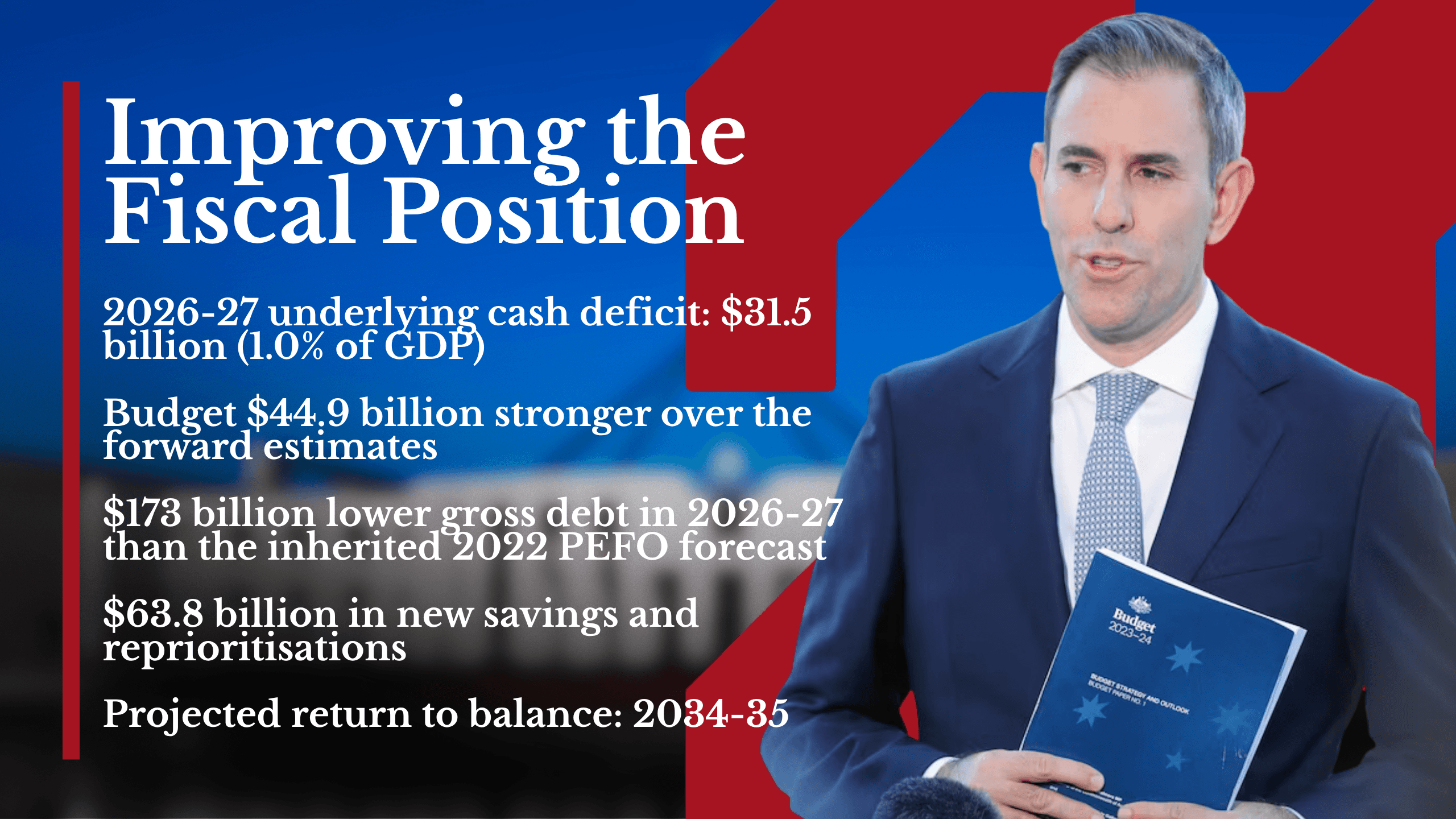
The 2026-27 Budget records an underlying cash deficit of $31.5 billion (1.0 per cent of GDP), with the fiscal position $44.9 billion stronger over the forward estimates than the December 2025 mid-year update. Gross debt now peaks earlier and lower than previously forecast, and the Government has banked further savings and reprioritisations totalling $63.8 billion in this Budget alone.
Economy
Budget 2026-27
The Budget was framed in conditions of heightened global uncertainty driven by the Middle East conflict and the resulting oil supply shock. Inflation is forecast at 5 per cent through the year to the June quarter 2026, and growth in 2026-27 is forecast to slow to 1.75 per cent. Despite these pressures, the underlying cash balance and gross debt trajectories are both stronger than at the December mid-year economic and fiscal outlook (MYEFO) and substantially stronger than the position inherited at the 2022 pre-election economic and fiscal outlook (PEFO).
Underlying Cash Balance
The underlying cash deficit is projected at 1.0 per cent of GDP in 2026-27, narrowing to 0.7 per cent of GDP in 2029-30. In every year of the projection period, the deficit is smaller than was forecast at MYEFO. The cumulative improvement over the forward estimates is $44.9 billion. Over the eight years to 2029-30, the fiscal position is more than a quarter of a trillion dollars better than the estimate inherited in 2022.
The Government has now recorded positive net policy decisions for two consecutive updates, meaning savings and reprioritisations exceed the cost of new spending decisions. Net decisions across the Budget cycle are positive by $26.1 billion when responsible provisions made in previous updates are included. Every dollar of upgraded revenue has also been returned to the budget rather than spent in both of the most recent updates.
Gross Debt
Gross debt in 2026-27 is $1,051 billion (34.0 per cent of GDP), rising in dollar terms to $1,249 billion by 2029-30 (35.6 per cent of GDP). In every year of the forwards, gross debt as a share of GDP is lower than was projected at MYEFO. The peak ratio of gross debt to GDP is now 1.2 percentage points lower than the MYEFO forecast.
Compared to the position inherited at the 2022 PEFO, gross debt in 2026-27 is $173 billion lower in dollar terms, and the projected peak debt-to-GDP ratio has fallen from 44.9 per cent (under 2022 PEFO settings) to 35.8 per cent, a reduction of 9.1 percentage points of GDP. This lower trajectory is estimated to avoid more than $70 billion in interest costs over the medium term.
Savings and Spending Restraint
The Budget contains $63.8 billion of new savings and reprioritisations, bringing the cumulative total of savings since the Government came to office to $177.9 billion. Real payments growth has averaged just 1.5 per cent per year over the eight years to 2029-30, less than half the 30-year average. Payments as a share of GDP are forecast to fall from 26.8 per cent in 2026-27 to 26.2 per cent in 2029-30, reflecting structural action on key spending pressures including the NDIS reforms.
Return to Balance
The budget is projected to return to balance in 2034-35. Gross debt as a share of the economy is expected to fall below 30 per cent by the end of the medium term.
Trade-offs
The headline figures describe improvements relative to previous forecasts, not an absolute return to surplus. The Budget remains in deficit in every year of the forwards, with the underlying cash balance projected at approximately $30 billion in deficit each year out to 2028-29 before narrowing in 2029-30. Gross debt continues to rise in dollar terms over the forwards, even as its share of GDP stabilises below earlier projections.
A return to balance in 2034-35 is around eight years from the current Budget. The longer-term improvements depend on continued spending restraint and follow-through on the structural reforms underpinning the Budget, including the NDIS reforms, the discretionary trust minimum tax, and the negative gearing and CGT changes that fund the broader tax package. Standard & Poor's reaffirmed Australia's AAA sovereign credit rating after the 2024-25 Final Budget Outcome.
Key Figures
2026-27 underlying cash deficit: $31.5 billion (1.0% of GDP)
2029-30 underlying cash deficit: $25.3 billion (0.7% of GDP)
$44.9 billion improvement over the forward estimates vs December 2025 MYEFO
More than $250 billion better over eight years vs inherited 2022 PEFO estimate
$63.8 billion in new savings and reprioritisations in this Budget
$177.9 billion in cumulative savings since coming to office
Gross debt 2026-27: $1,051 billion (34.0% of GDP)
$173 billion lower gross debt in 2026-27 than 2022 PEFO forecast
Projected peak debt-to-GDP: 35.8% (down from 44.9% at 2022 PEFO)
More than $70 billion in interest costs avoided over the medium term
Real payments growth: 1.5% per year over the eight years to 2029-30
Projected return to balance: 2034-35
Sources
[1] Budget 2026-27 Overview: Responsible economic and fiscal management
Updated: