
Fixing our migration system + Skills Reform
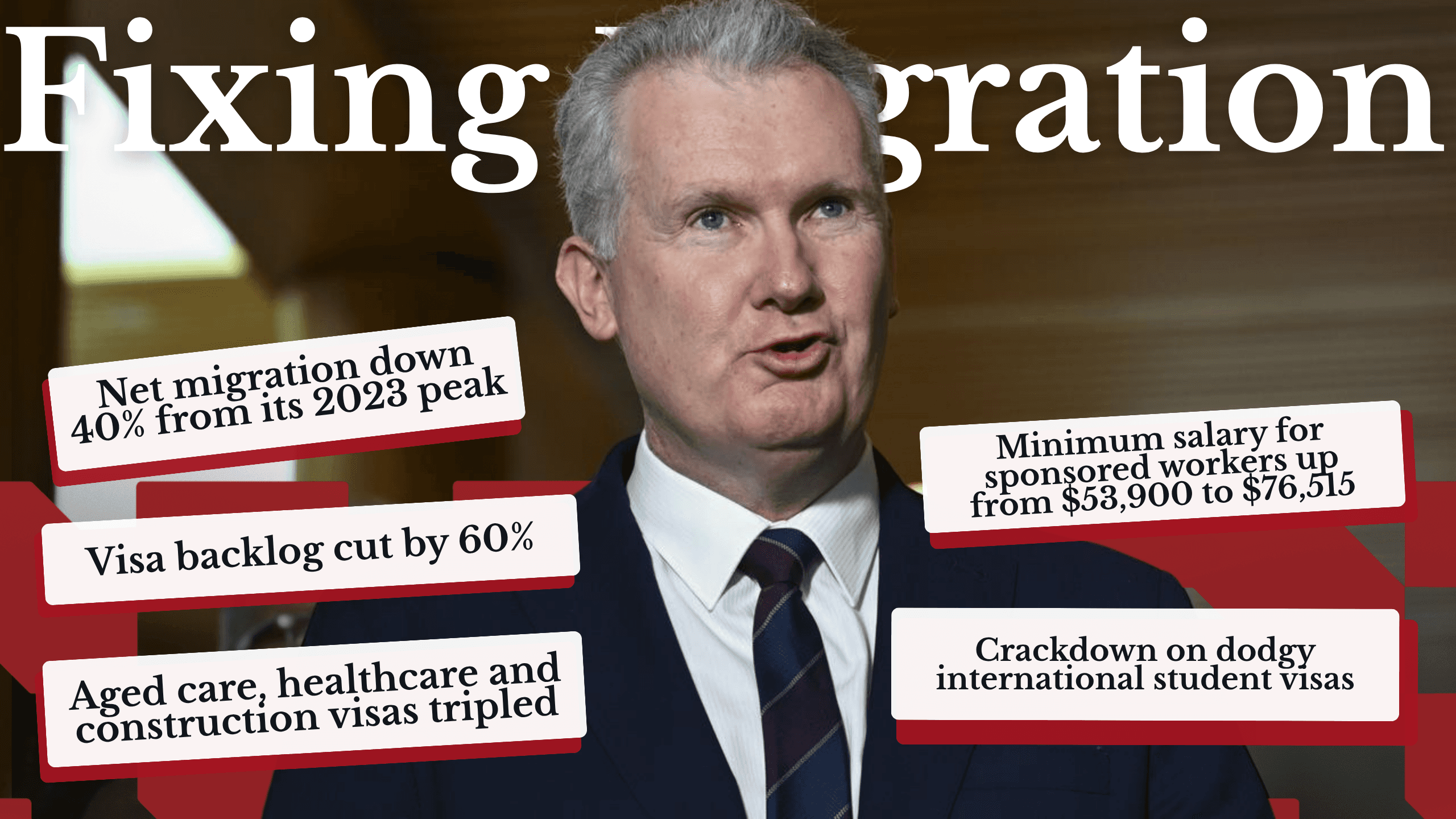
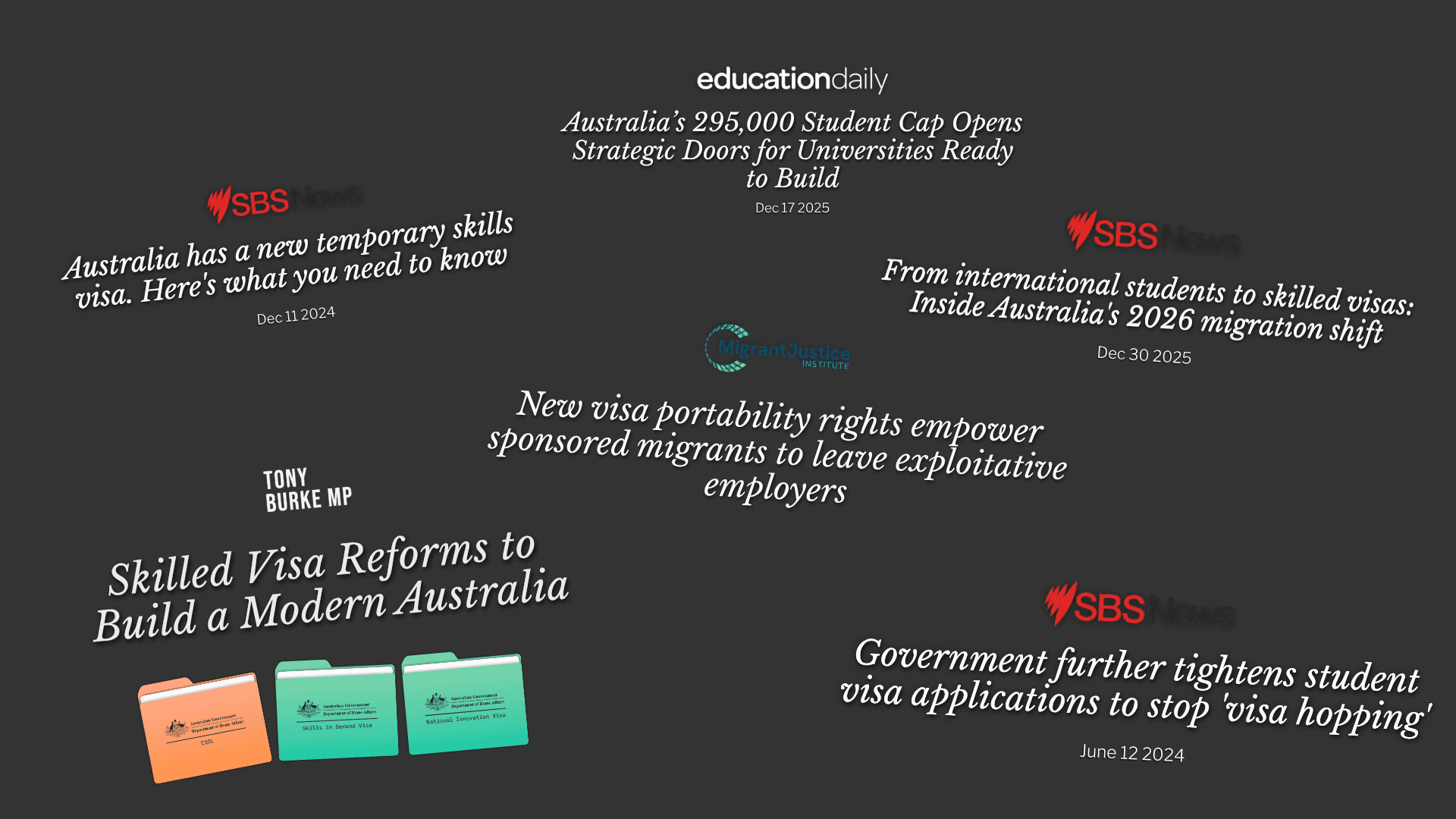
The Albanese Government inherited a migration system that the Parkinson Review described as "broken" and requiring a decade-long rebuild. Across Labor's first term and into its second, the temporary skilled visa was rebuilt from the ground up, the long-frozen minimum salary was lifted and indexed, sponsored workers gained the right to change jobs without losing their visa, the student-visa channel was tightened, and net overseas migration has fallen more than 40 per cent from its 2023 peak. The 2026-27 Budget, handed down on 12 May 2026, locks in the structural shift.
Economy
Term 2
Alright this is a big one, so buckle up:
Context
Labor's 2025 federal election result on 3 May 2025 returned the Albanese Government with 94 seats, the largest majority for a Labor government in over a century and a Senate majority that has made migration policy unusually predictable. The Coalition went to the election promising to cut the permanent program from 185,000 to 140,000 and to slash NOM by 100,000. The result, combined with continuing Coalition disarray, has given the government room to keep refining rather than overhauling the Migration Strategy framework set out in December 2023.

Labor's framing
Home Affairs Minister Tony Burke, in his National Press Club address on 16 October 2025, set out the government's frame for the migration debate.
He argued that the post-pandemic surge in net overseas migration was always going to occur for two structural reasons: students who had deferred for one, two or three years all arrived in the same cohort, and rolling forward of visa expiry dates collapsed the natural staggering of departures.
Burke also challenged the Coalition's call for deeper cuts to NOM with a direct question: which visa class. The 2024 program included 21,000 healthcare-worker visas, 4,300 teacher visas and 15,524 construction visas (a tripling of construction places).
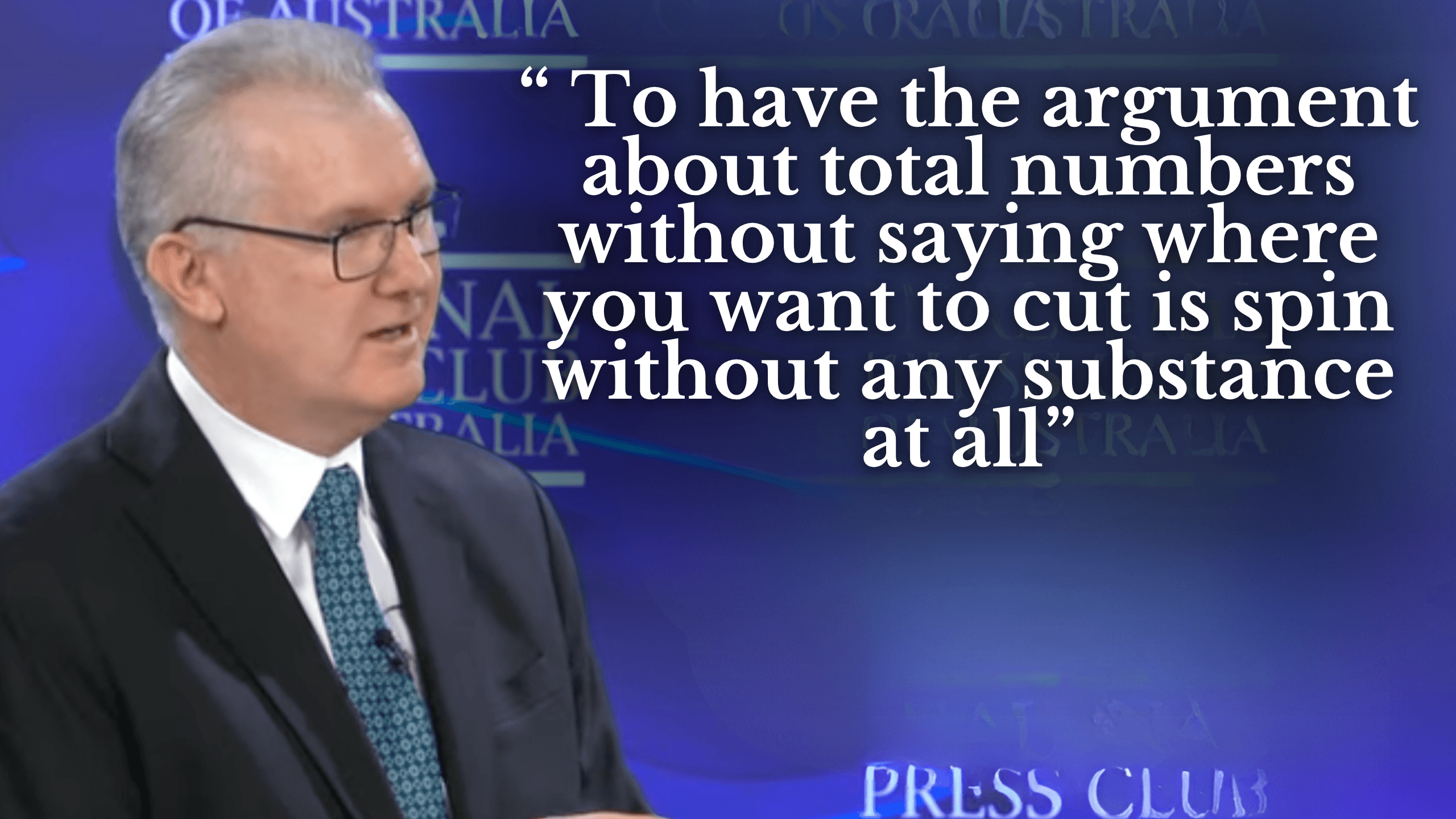
The argument from government has been that further cuts must specify which hospitals run short of staff, which education providers reduce their offerings, and which construction projects (including housing) are delayed.
1. The inherited problem
Three pressures converged by mid-2022, when Labor took office.
The Coalition-era freeze. The Temporary Skilled Migration Income Threshold (TSMIT), the minimum salary an employer must pay a sponsored worker, was set at $53,900 in 2013 and then frozen for a decade, including the six years Peter Dutton was Home Affairs Minister. By 2022, roughly 90 per cent of full-time Australian jobs paid more than that floor, meaning "skilled" migration was being used to fill jobs that were no longer, by salary, skilled.
The COVID backlog. Closed borders from March 2020 to early 2022 saw more than 600,000 temporary visa holders leave Australia. The Productivity Commission estimated 380,000 fewer people entered the workforce, costing the economy roughly $32 billion. By August 2022, the visa backlog stood at over 914,000 applications.
The "permanently temporary" problem. The temporary migrant cohort had doubled from 900,000 in 2007 to 1.8 million by 2023. Many were on rolling short-term visas with no realistic pathway to permanent residence, an arrangement the review found created an "emerging permanently temporary underclass" vulnerable to exploitation.
2. The Parkinson Review (April 2023)
Home Affairs Minister Clare O'Neil commissioned a review led by former Treasury Secretary Dr Martin Parkinson, alongside Joanna Howe and John Azarias. Delivered in March 2023 and released in April, the final report concluded the system was "so badly broken it needs a 10-year rebuild". Key findings:
The Skilled Occupations List could not keep up with labour market changes
Australia was losing the global competition for the most highly skilled migrants
Systemic exploitation was widespread in lower-paid temporary work
The points test for permanent residence was failing to select the migrants most likely to succeed long-term
The Albanese Government accepted the diagnosis and committed to a comprehensive response.

3. The Migration Strategy (11 December 2023)
The Migration Strategy is the operational answer to the Parkinson Review. It is built around five objectives (productivity, fair workplaces, community planning, regional partnerships, system efficiency) and eight key actions.
How the headline targets have tracked
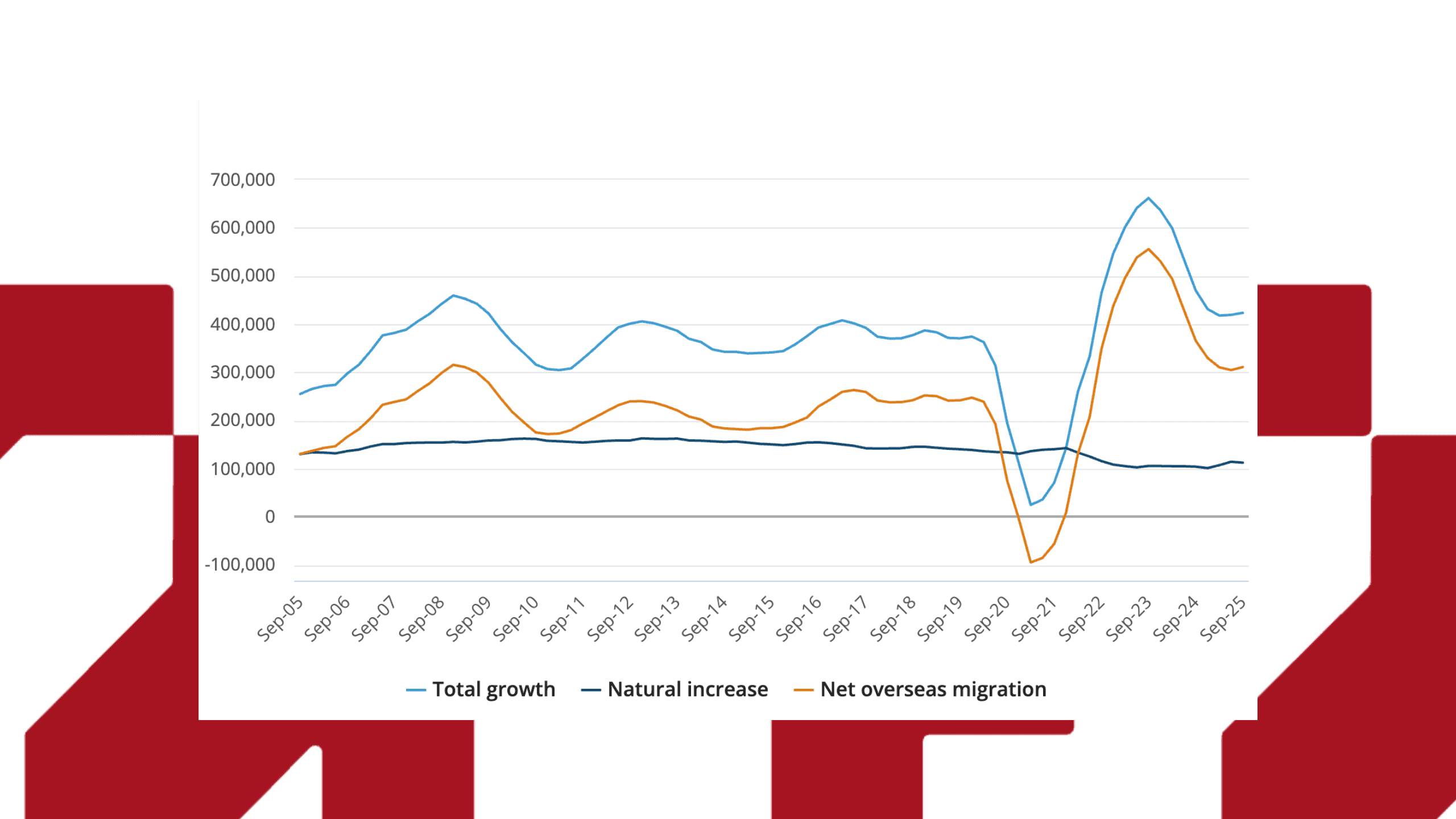
The strategy set out to halve net overseas migration from 528,000 in 2022-23 to around 260,000 by 2024-25. The actual outcome for 2024-25 was 306,000, short of the target but down more than 40 per cent from the peak. The permanent program has been held at 185,000 places across 2024-25, 2025-26 and 2026-27, with roughly 70 per cent allocated to the skilled stream. The 7-day processing standard for the new Specialist Skills pathway commenced with the Skills in Demand visa on 7 December 2024 and is the fastest service standard ever offered for an Australian work visa.
4. Skills in Demand visa: the new temporary skilled architecture
The subclass 482 Temporary Skill Shortage visa was replaced on 7 December 2024 by the Skills in Demand (SID) visa, retaining the 482 subclass number but restructured into three streams targeted at different parts of the labour market.
Specialist Skills stream. For workers earning $135,000 or more (the Specialist Skills Income Threshold, indexed annually to Average Weekly Ordinary Time Earnings). No occupation list. Service standard of 7 days for processing. Designed to win the global competition for top talent.
Core Skills stream. For workers earning at least the Core Skills Income Threshold (CSIT) of $73,150 for 2025-26, in an occupation on the Core Skills Occupation List (CSOL). The CSOL contains 456 occupations and is maintained by Jobs and Skills Australia, replacing the old static Skilled Occupation List with a list built from genuine labour market evidence.
Essential Skills stream. For workers below the CSIT in critical sectors, primarily aged care, disability support and regional industries. Operates through industry labour agreements with union-employer memoranda. Currently the Labour Agreement stream, to be formally rebranded.
Mechanism changes
TSMIT raised from $53,900 to $70,000 on 1 July 2023, then indexed annually. The Core Skills equivalent (CSIT) is $73,150 in 2025-26 and projected to reach $79,499 by July 2026
Worker mobility. Visa holders can now cease working for their sponsoring employer for up to 180 days at a stretch, or 365 days total over the visa term, and work for other employers in the meantime. The previous limit was 60 days, after which the worker faced removal. This single change shifts the power balance away from employers who used visa dependency to suppress complaints
Work experience requirement cut from 2 years to 1 year of relevant full-time work in the past 5 years
Visa length of up to 4 years, with clearer pathways to permanent residence
5. Permanent residence and the points test
The permanent program is held at 185,000 places for 2025-26 and again for 2026-27, with a roughly 70:30 split between Skilled and Family streams. The 2026-27 design is built around onshore prioritisation: 129,590 of the 185,000 places (around 70 per cent) are reserved for migrants already living in Australia, with only 55,110 places allocated offshore. The government's argument is that converting temporary residents to permanent residents does not add to net overseas migration, because the people involved are already counted in the population. In 2024-25, 61 per cent of permanent skilled visas and 39 per cent of permanent family visas were issued onshore.
The 2026-27 composition also shifts within the Skilled program: Skilled Independent rises from 16,900 to 21,090; Employer-Sponsored rises from 44,000 to 58,040; the Regional category (subclass 491) falls from 33,000 to 14,110; State and Territory Nominated rises from 33,000 to 35,500; and Talent and Innovation falls from 5,300 to 3,500 as the National Innovation Visa replaces the older Global Talent and Distinguished Talent visas.
Employer Nomination Scheme (subclass 186). The Direct Entry stream now uses the same CSOL as the temporary visa, so the occupation lists for temporary and permanent skilled work are aligned for the first time. The Temporary Residence Transition (TRT) stream, which converts temporary sponsored workers into permanent residents, was tightened from 29 November 2025 to require continuous approved sponsorship.
Points test review. A discussion paper released in April 2024 received 204 submissions. The proposed reforms, expected to take effect from July 2026, include:
Increasing maximum points from 130 to 500 to allow finer discrimination
Removing the bonus points for Australian study (research found graduates who studied in Australia earn around 10 per cent less than equivalent migrants who studied abroad)
Giving partners' English, qualifications and skilled work experience greater weight
Sliding-scale age points modelled on Canada's system
Heavier weighting for high-paying Australian work experience, as a stronger predictor of long-term contribution than degrees alone
6. International students
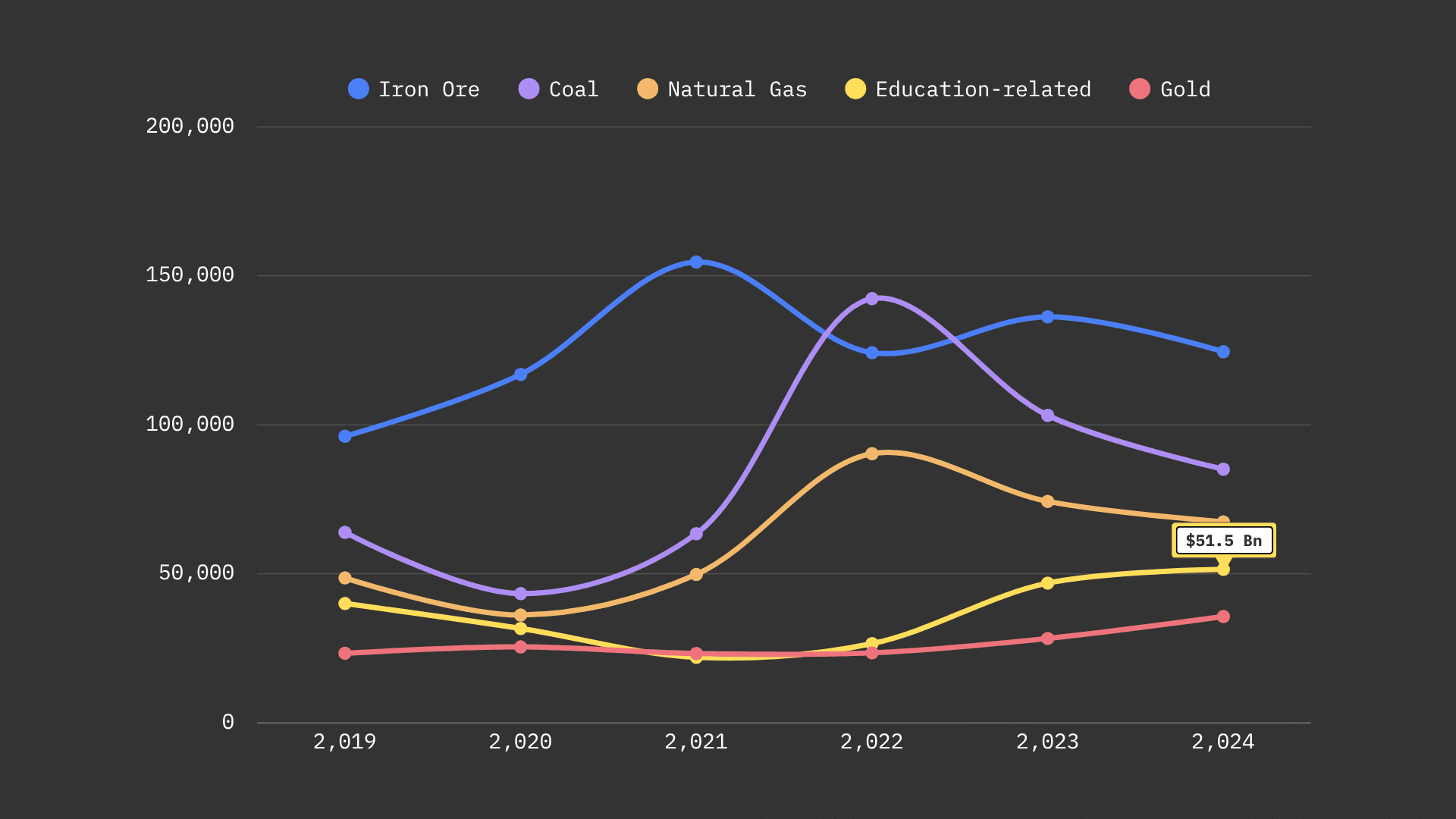
International education is Australia's fourth-largest export, but the system had become a quasi-migration channel rather than a study channel.
Labor's integrity measures:
Genuine Student test replaced the Genuine Temporary Entrant test from 23 March 2024, requiring applicants to explain their course choice, career fit and intent to comply with visa conditions
English requirements raised from IELTS 5.5 to 6.0 for Student visas, and from 6.0 to 6.5 for the Temporary Graduate (485) visa
Temporary Graduate visa age cap reduced from 50 to 35 from 1 July 2024 (Masters research and PhD graduates remain eligible to 50). Duration cut: 18 months for vocational, 2 years for bachelor degrees, with the "select degree" 2-year extension removed
Visa hopping restricted, with fewer onshore visa-switching options. The government estimates up to 180,000 temporary visa holders may need to depart by mid-2026
Student visa caps. A 270,000 cap on new international student commencements for 2025 (145,000 universities, 95,000 vocational), implemented via Ministerial Direction 107, then replaced by MD 111 in December 2024 and MD 115 in November 2025. The mechanism: applications to a given provider are processed at high priority until 80 per cent of that provider's allocation is reached, then drop to standard priority
7. Pacific Engagement Visa
The Pacific Engagement Visa (subclass 192) opened ballot registrations on 3 June 2024. Up to 3,000 visas per year (including partners and children) are allocated by random ballot to nationals of Federated States of Micronesia, Fiji, Nauru, Palau, Papua New Guinea, Solomon Islands, Timor-Leste, Tonga, Tuvalu and Vanuatu. Successful ballot entrants must secure a job offer in Australia. Ballot entry costs $25. The visa is a permanent residence grant on arrival and reflects a foreign-policy goal of deepening Pacific ties as much as a labour-supply tool.
8. Pacific Australia Labour Mobility (PALM) scheme
The PALM scheme, which brings Pacific workers into seasonal and longer-term low-skilled work, was reformed in 2023-24 with measures effective from 26 June 2023:
Minimum 30 hours of paid work per week guaranteed
Pay parity with domestic workers in the same role
Employer-provided accommodation and transport
Medicare access for long-term workers and their accompanying families
A family accompaniment pilot for 200 long-term workers from July 2023
ATO support to recover Departing Australia Superannuation Payment
PALM participation fell 24 per cent between July 2023 and July 2024, in part because other temporary worker pools (backpackers, students) returned.
9. Migrant worker protections
Three measures targeting exploitation:
Workplace Justice visa (subclass 408 pilot from 1 July 2024). Exploited migrants can stay in Australia for 6 to 12 months (extendable to 4 years) on a work-permitted visa to pursue civil or criminal action against their employer, at no cost
Visa protections for migrant workers who breach a visa condition (typically by working over hour limits) but report exploitation. Previously, reporting meant risking visa cancellation
Employer prohibitions. From 1 July 2024, employers found to have seriously, repeatedly or deliberately exploited migrant workers may be barred from employing further temporary migrant workers
10. Aged Care Industry Labour Agreement
A sector-specific agreement allowing aged care providers to sponsor migrant carers via the 482 SID visa or permanent 186 ENS visa with concessions on salary thresholds, English and age. Minimum salary $51,222 versus the standard TSMIT of $76,515 (FY26 figure), in exchange for a Memorandum of Understanding with the Health Services Union, United Workers Union and Australian Nursing and Midwifery Federation. The union-employer mechanism aims to prevent the salary concession becoming a wage-suppression channel.
11. Outcomes and trade-offs
Net overseas migration trajectory:
2022-23: 538,000 (peak, reflecting post-COVID rebound)
2023-24: 429,000
2024-25: 306,000 (seven consecutive quarters of decline)
Total NOM has fallen more than 40 per cent from its 2023 peak, the figure the government cites in defending its overall record.
Visa backlog: The Department of Home Affairs reports a 60 per cent reduction in on-hand TSS visa applications since December 2024. Late-2024 Skilled Independent (189) applications have largely been cleared.
Sector breakdown for 2024 grants: 21,000 healthcare worker visas, 4,300 teacher visas, 15,524 construction visas (tripled).

Considerations
The headline target was to roughly halve NOM to 260,000 by 2024-25. The 2024-25 outcome of 306,000 is short of that target, and 2024 saw an unexpected surge driven by long-term student arrivals that compressed the year-on-year decline.
The Temporary Graduate visa changes have been criticised by universities and student bodies for cutting off the post-study work pathway abruptly for thousands of mid-30s graduates already in the country. The student caps, by design, redistribute enrolments away from large universities that had become heavily dependent on international fee revenue, with consequences for university budgets that the sector has not fully digested.
Skills recognition remains an unresolved structural problem. Around 50 per cent of skilled migrants work below their qualification level for some period after arrival, with recognition bottlenecks worst for humanitarian entrants and former students. Recognition is largely a state-based or non-government regulator function, which constrains what Commonwealth policy alone can do. The government is examining proposals (including an ombudsman-style role within Jobs and Skills Australia) and offshore certificate-level training that could compress the gap, but no announcement has been made.
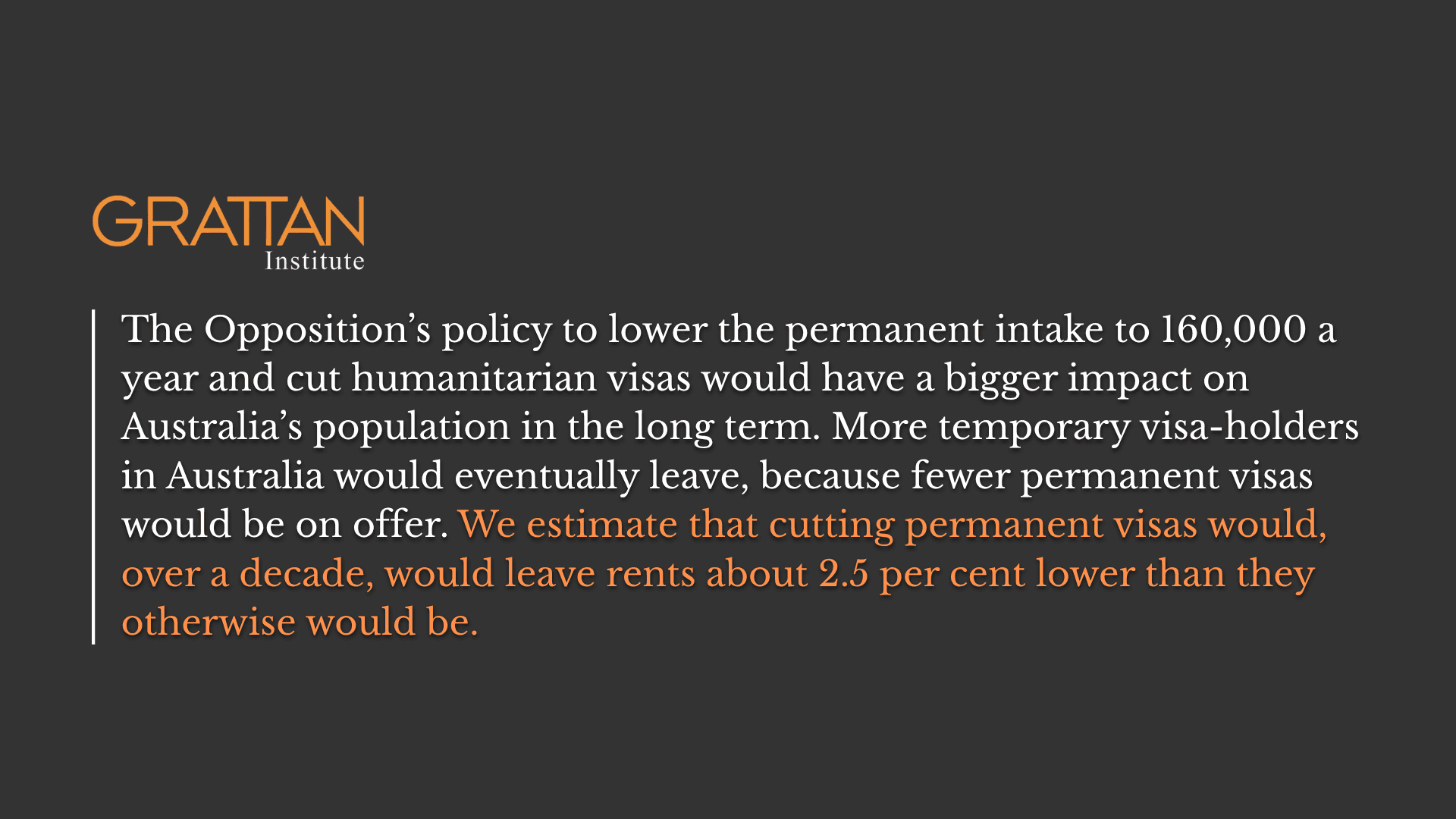
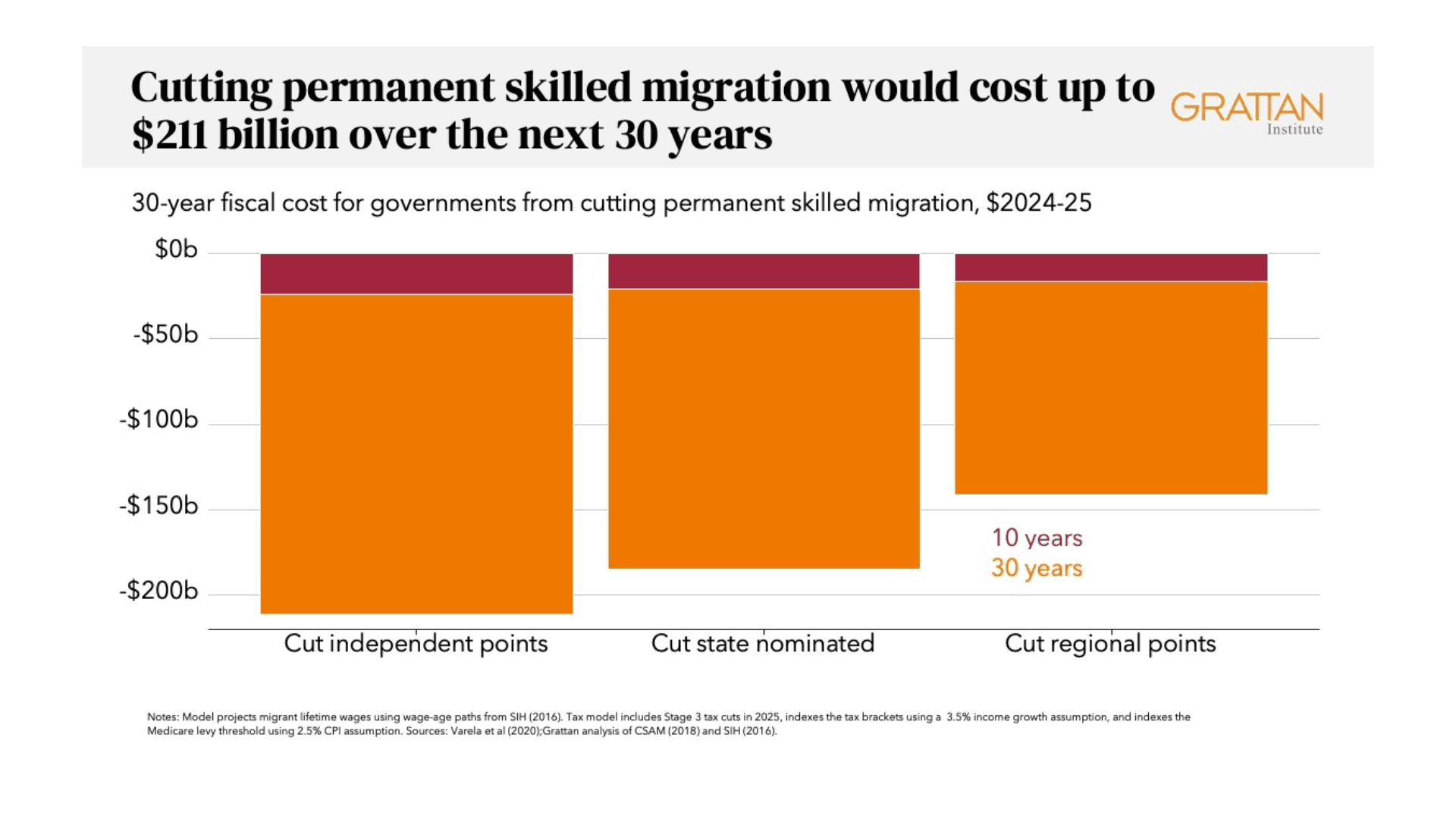
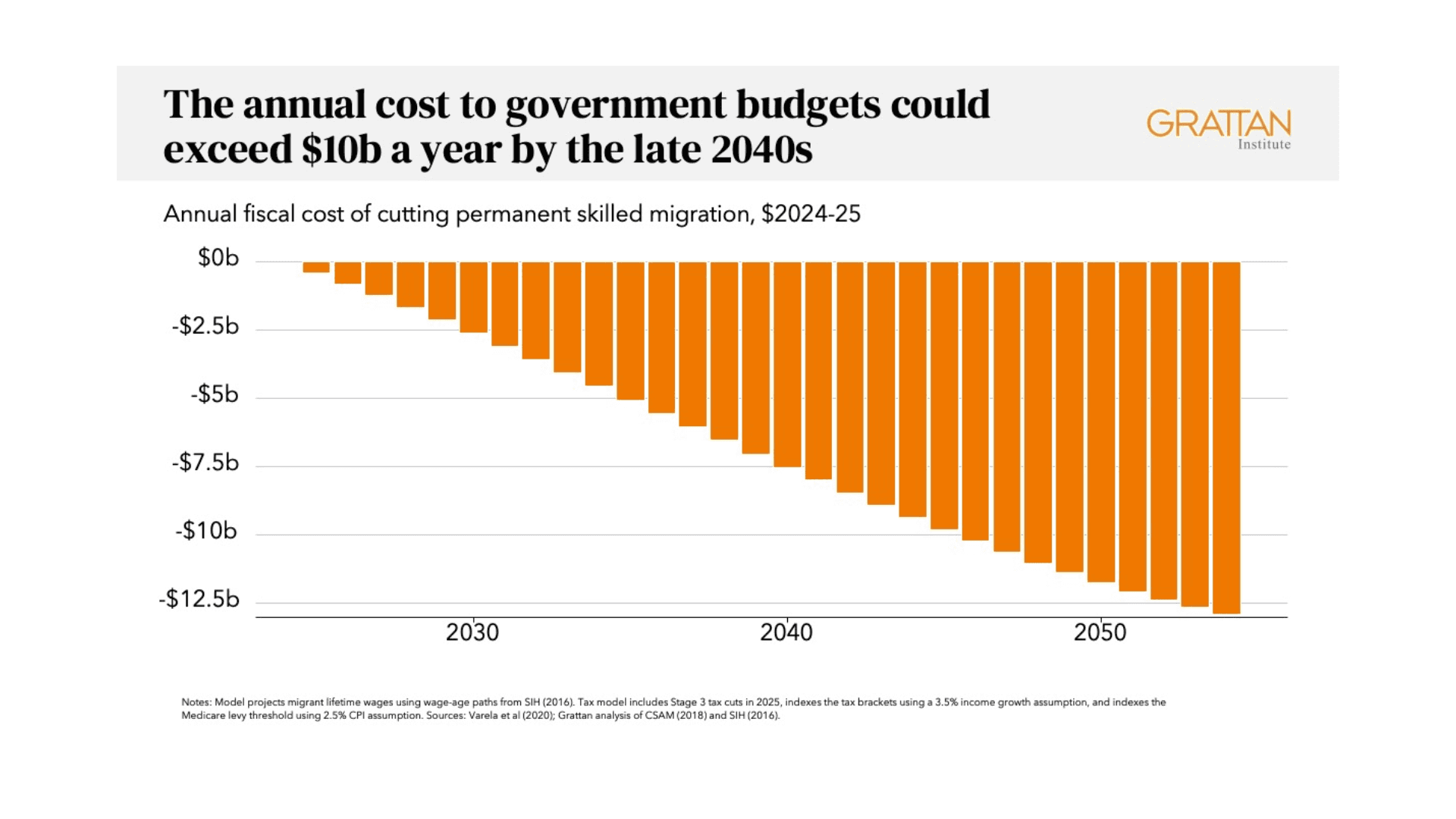
The Coalition under Peter Dutton proposed cutting the permanent program from 185,000 to 140,000 and slashing NOM by a further 100,000, arguing the housing crisis demanded it. Labor's response has been that those cuts would hollow out construction, aged care and tourism, while having only marginal housing effects given that around 61 per cent of permanent skilled visa grants in 2024-25 went to people already in Australia. The Grattan Institute's modelling highlighted significant concerns with this approach.
Burke has also flagged AUKUS as a structural upward pressure on NOM through the late 2020s, particularly in South Australia and Western Australia, where defence shipbuilding will pull domestic workers into high-paying jobs that must then be backfilled. The government's position is that NOM cannot be reduced to a single target number because some drivers (Australian citizens leaving and returning, AUKUS demand, housing supply) are outside its direct control.
Where Labor's record stands
The Migration Strategy is the most substantial structural rewrite of Australia's temporary skilled migration system since the 457 visa was introduced in 1996. It restored the salary floor and indexed it, replaced a discredited occupation list with a labour-market-evidenced one, redistributed power from sponsoring employers to workers via the 180-day mobility window, created enforceable rights for exploited workers, and tightened the integrity of the international student channel. Net overseas migration is down by 232,000 over two years. The remaining work, the points test reform (due 1 July 2026), the full Essential Skills stream rollout, and aligning permanent and temporary pathways, is sequenced through 2026 and 2027.
12. 2026-27 Budget measures
The 12 May 2026 Budget added three further pieces to the framework:
$85.2 million over four years to the Department of Employment and Workplace Relations to accelerate skills assessments for migrant workers, designed to bring in up to 4,000 additional skilled trades workers per year (primarily construction and electrical)
Confirmation of the 185,000 permanent program with the onshore-prioritisation design described above
An adjustment to the state-nominated and regional category allocations responding to AUKUS-driven labour demand in WA and SA
The Budget framing positioned migration, housing supply and labour market policy as a single integrated package, reflecting the Productivity Commission's 2026 finding that Australian house construction takes roughly twice as long as it did 30 years ago, in part due to a shortage of skilled construction workers.
13. Expert commentary
Grattan Institute. Has argued for collapsing the Skilled Independent, State-Nominated and Regional streams into a single points-tested visa, with points only for characteristics that predict migrant success. Recommends targeting permanent skilled visas at younger, high-human-capital applicants and making permanent employer sponsorship available for any occupation paying above $85,000. Also recommends abolishing the Business Investment and Innovation Program (which selects older and less-skilled migrants), saving the budget up to $34 billion over three decades. Several Grattan recommendations have flowed into the proposed points-test reform.
CEDA (Committee for Economic Development of Australia). Supported the lift in TSMIT to $70,000 and the broader Skills in Demand architecture. Recommends a three-tier risk-based approach with a fast-track for high-paid, highly-skilled intra-company transfers. Calls for a tripartite (government, business, unions) governance model to avoid "the revolving door of ad-hoc reviews", and for tackling skills recognition through structural reform rather than one-off programs.
Peter McDonald (Emeritus Professor of Demography, ANU Crawford School). Sits on the Ministerial Advisory Council on Skilled Migration. Argues that NOM is the wrong headline measure because it does not capture the temporary migrant stock. Proposes anchoring temporary migration to permanent settlement capacity, so the public can see how many temporary residents are realistically able to transition to permanent residence. With Alan Gamlen, has argued for redefining the Migration Program around the skilled stream to restore employer confidence and clarify temporary-to-permanent pathways.
ANU Policy Brief and Melbourne Institute. Have explained the 2024 NOM surge as a one-off statistical effect: students who deferred during the pandemic arrived in compressed cohorts, and visa renewal cycles temporarily de-synchronised. This supports the government's framing that the rebound was not a policy failure, and that the subsequent decline reflects the structural changes biting.
Migrant Justice Institute and the Human Rights Law Centre. Have welcomed the Workplace Justice visa as a "world-first" reform that breaks the dependence-on-employer trap, while pressing for the pilot to be made permanent and for the visa to cover a wider range of exploitation scenarios.
Key figures
TSMIT: $53,900 (2013-2023) lifted to $70,000 on 1 July 2023, then indexed annually
Core Skills Income Threshold: $73,150 (2025-26), projected $79,499 by July 2026
Specialist Skills Income Threshold: $135,000
Core Skills Occupation List: 456 occupations, maintained by Jobs and Skills Australia
Worker mobility window: 180 days continuous, 365 days total
Specialist Skills processing target: 7 days
Permanent program: 185,000 places (2025-26 and 2026-27), 70:30 Skilled:Family split
2026-27 onshore allocation: 129,590 of 185,000 places (70 per cent)
2026-27 Skilled stream composition: Employer-Sponsored 58,040, State/Territory Nominated 35,500, Skilled Independent 21,090, Regional 14,110, Talent and Innovation 3,500
2024 sector grants: 21,000 healthcare, 4,300 teachers, 15,524 construction
NOM fall from 2023 peak: more than 40 per cent
Student commencements cap: 270,000 (2025), 295,000 (2026)
Pacific Engagement Visa: up to 3,000 per year
Net overseas migration: 538,000 (2022-23), 429,000 (2023-24), 306,000 (2024-25)
Visa backlog reduction: 60 per cent reduction in on-hand TSS applications since December 2024
2026-27 Budget skills assessment funding: $85.2 million over four years, around 4,000 additional skilled trades workers per year
Sources
[1] Review of the migration system: final report (Parkinson Review)
[2] Migration Strategy, Department of Home Affairs
[3] Overseas Migration 2024-25, Australian Bureau of Statistics
[4] Permanent Migration Program planning levels, Department of Home Affairs
[5] Skills in Demand visa (subclass 482), Department of Home Affairs
[6] Tony Burke, National Press Club Address, 16 October 2025
[7] Australia's migration opportunity, Grattan Institute
[8] Explaining the 2024 Net Overseas Migration surge, ANU Policy Brief
Updated: